1953 JEEP CJ drain bolt
[x] Cancel search: drain boltPage 167 of 376

'Jeep*
UNIVERSAL
SERIES
SERVICE
MANUAL
FIG.
G-8—TEMPERATURE SENDING UNIT- HURRICANE
F4
ENGINE
1—Temperature
Sending Unit
b.
Dauntless V-6 Engine.
The
thermo-couple coolant sending unit is mounted
in
the left
rear
area of the intake manifold and is
connected by a single wire to the dash unit of
the instrument cluster.
G-ll.
WATER PUMP
a.
Hurricane
F4 Engine.
The
water pump on the
Hurricane
F4
engine
is a
centrifugal
impeller type of large capacity to
cir
culate water in the entire cooling system. The double row
ball
bearing (Fig. G-9), is integral with
the shaft and is packed at assembly with a special
high melting point grease which
will
last the life of
the bearing. The bearing is sealed to retain the
lubricant
and prevent
dirt
and dust from entering.
The
bearing and shaft are retained in the water
pump body by the bearing retaining wire. The
water
seal bears against the ground seat on the
pump body and the inside of the impeller, maintain
ing a constant pressure against both and preventing
water
leakage. A
drain
hole
in the
bottom
of the
pump body precludes any water
seepage
past the
seal
from entering the bearing.
The
impeller and the pulley hub are pressed on
the shaft under high pressure,
b.
Dauntless V-6 Engine.
A
centrifugal-type water pump, shown in
Fig.
G-10,
circulates
coolant through the Dauntless V-6
engine
and
its cooling system.
This
pump is mounted on
the timing chain cover.
Similar
to the
engine
cooling
fan
mounted on its hub, the pump is driven through
a
V-belt from the crankshaft pulley.
Coolant
enters the water pump at its center.
Centri
fugal force then forces coolant radially outward, through vanes of the pump impeller, and backward
through two discharge passages in the timing chain cover. These passages conduct an equal amount of
coolant to each cylinder bank water jacket.
This
water
pump has a sealed double row
ball
bearing
and
a ceramic water seal, neither of which can be
serviced.
In
event
of bearing or water seal failure, the entire water pump assembly must be replaced.
G-l2.
Water
Pump Inspection
Check
the water pump for leaks, and excessive end play or
looseness
of the shaft in the pump. A
quick
way to check is to work the fan blades up
and
down by hand. If any play is noticed, this
indicates that the bearings are rough. Rough bearings should be checked to see if the water pump
should be replaced or rebuilt.
G-13.
Water Pump
Disassembly
—
Hurricane
F4
Engine
•
Refer to Fig. G-9.
a.
Remove the fan belt, fan blades, and fan pulley.
b.
Remove the
bolts
attaching the water pump
to the block. Remove the pump.
c.
Remove the bearing retainer spring.
d.
Remove the pump impeller and pulley with a suitable puller.
e.
Remove the pump seal, bearing and shaft, and
bearing
slinger.
G-l4.
Water Pump Reassembly
—
Hurricane
F4
Engine
•
Refer to Fig. G-9.
Before assembling the water pump, examine water
seal
seat in the pump body and should it be rough,
install
a new pump body.
To
reassemble the unit, insert the long end of the shaft into the pump body from the front end until
the outer end of the bearing is flush against the
FIG.
G-9—WATER
PUMP-
HURRICANE
F4
ENGINE
1—
Fan
and Pump Pulley
2—
Bearing
and Shaft
3—
Bearing
Retainer Spring
A—Pipe
Plug 5—
Pump
Body
6—
Seal
Washer 7—
Pump
Seal
8—
Impeller
9—
Gasket
167
Page 169 of 376

'Jeep'
UNIVERSAL
SERIES SERVICE
MANUAL
G
cation period. It is
good
preventive maintenance to
replace a badly frayed, worn or cracked fan belt
before it breaks in operation.
To
replace the fan belt,
loosen
the attaching
bolts
at each generator or alternator brace-to-engine mounting and pivot the alternator or generator to
ward
the
engine
to gain slack needed to install the new belt Remove the old belt. Position the new
belt over the fan pulley, over the crankshaft pulley,
then over the generator or alternator pulley.
Pull
the generator or alternator away from the
engine
until
belt tension is
firm.
Then tighten the generator
or
alternator mounting
bolts
and check the tension
as indicated above. Reset the generator or alternator as necessary for correct belt tension.
Finally,
torque
the generator or alternator mounting
bolts
25 to 35 lb-ft. [3,4 a 4,8 kg-m.].
Note:
On the Dauntless V-6
engine
when adjusting
the fan belt tension, the alternator mounting
bolts
should be torqued 30 to 40 lb-ft. [4,14 to 5,53
kg-m.].
If a fan belt tension
gauge
(W-283) is
avail
able, proper tension should be 80 pounds [36,2 kg.].
G-l
9. Engine Overheating
An
engine
will
not be damaged by high coolant
temperatures unless the coolant boils. The pres
surized
cooling system on the 'Jeep' vehicles raises the boiling point of the coolant solution. Should
overheating be encountered, and the fault is be
lieved to be in the cooling system check for the
following:
a.
Proper coolant level. See
Filling
Cooling Sys
tem Par. G-2.
b. Poor air flow.
Check
for dirty radiator core. (See Radiator Par. G-5).
Check
for faulty belt
pulley operation, worn or
loose
fan belt, or dam aged fan.
Clean,
repair, replace or adjust as neces
sary.
c. Foaming coolant.
Check
for air leaks at water
pump,
hose
connection and filler cap. Tighten, re
pair
or replace as necessary.
d.
Surging or "after boil".
Check
pressure cap and
replace if valves or gasket are faulty.
e.
External
leaks.
Check
the following for leaks:
Hoses and clamps, water pump, radiator, head gas
ket, core plugs and drain cocks, as well as the cylin der head or block for
cracks.
f.
Internal
leaks.
Check
for faulty head gasket,
cracked
cylinder head or block.
g. Poor coolant flow.
Check
hose
condition, water pump, fan belt, and repair or replace as necessary. Inspect block for rust or scale, and clean and flush
the system, if necessary.
h.
Check
the temperature
gauge.
169
Page 230 of 376

CLUTCH
is deeply scored or grooved, the part should be
replaced.
b. Inspect driven plate for wear or damage to fac
ings,
loose
rivets, broken or
loose
torsion springs,
and
flattened cushion springs. If facings are worn
near
rivets or are oily, replace the plate assembly.
A
slight amount of oil on clutch facings
will
cause
clutch
grab and chatter; excessive oil on facings
will
cause slippage. It is not practical to remove
oil
with solvents or by buffing since oil
will
con
tinue to bleed from facing material when hot. If
oil
is found on driven plate facings, examine trans
mission drainback hole, pilot bushing,
engine
rear
main
bearing and other points of possible oil leakage. Test the fit of driven plate hub on trans
mission main drive gear for an easy sliding fit.
c. Inspect clutch release bearing for scoring or ex cessive wear on front contact face. Test for rough
ness
of balls and races by pressing and turning
front race slowly. Inspect main drive gear pilot
bushing in crankshaft. Replace bushing if it is rough or worn. Regardless of whether the old plate
or
a new plate is to be installed, check the plate
for runout. Slide the driven plate, front side first,
over the transmission main drive gear shaft so that
it
is tight on the spline. Index a
dial
indicator to the plate facing as shown in
Fig.
1-9. While holding
firmly
against front end of main drive gear, to take up play in main drive gear bearing, slowly
rotate driven plate and observe the amount of
run
out shown by indicator. If runout of front facing
exceeds
.025" [0,635 mm.], replace the plate. It
is not practical to correct excessive runout by bending. 12769
FIG.
1-9—RUNOUT
CHECK
—
CLUTCH
PLATE
1—
Front
Facing
(Flywheel
Side)
2—
Dial
Indicator
Set
d.
Check
clutch pilot bushing for excessive wear
or
damage. Replace pilot bushing, if necessary, with
special
removal and installation
tools.
(See
Figs.
1-6 and 1-7). 1-13.
SERVICING
CLUTCH
PRESSURE
PLATE
AND
DISC
—
BORG
&
BECK
V6
(Late
Models)
The
Borg & Beck clutch is a single plate, dry disk
type. It provides smooth
engagement
of
engine
power to the wheels. The clutch consists of a pres
sure
plate assembly with pressure springs and
release levers, and driven plate assembly. The
driven
plate assembly
uses
spring center vibration
neutralizes and two flexible facings.
The
clutch driven plate is spring cushioned with a facing riveted to both sides. The coil springs around
the hub absorb the power shocks and cushion the
driving
mechanism. The clutch throw-out bearing is of the
ball
type, packed at time of manufacture,
and
requires no further lubrication.
No adjustment for wear is provided in the clutch itself. An individual adjustment is built into the
clutch
cover to adjust the height of the release
levers.
This
adjusting nut is locked in position
and
should never be disturbed unless the clutch assembly has been disassembled for the replace
ment of worn parts or to correct the height of the release levers.
When
the clutch pedal is depressed (disengaged),
the release bearing is moved toward the flywheel
and
contacts the inner ends of the release levers.
Each
lever is pivoted on a floating pin which re
mains stationary in the lever and rolls across a short flat portion of the enlarged
hole
in the eye-
bolt. The outer ends of the
eyebolts
extend
through
holes
in the stamped cover and are fitted
with
adjusting nuts to secure the levers in the
correct
position. The outer ends of the release levers
engage
the pressure plate lugs by means of ful-
crums,
which provide knife-edge contact
between
the outer ends of the levers and the lugs as shown
in
Fig.
I-10. 12190
FIG.
MO—CLUTCH
LEVER
POSITIONS
A—Clutch
Engaged
B—Clutch
Disengaged 1-14.
Clutch
Pressure Plate Adjustment
The
clutch pressure plate adjustment must be
checked before installing a new or reconditioned
clutch.
The proper spacer thickness and
gage
length for a particular clutch is listed in Par. 1-30.
Use
Clutch
Adjusting
Fixture
W-296. If the W-296
fixture is not available one can be fabricated as
described in Par. 1-26. 230
Page 267 of 376
'Jeep'
UNIVERSAL SERIES SERVICE
MANUAL
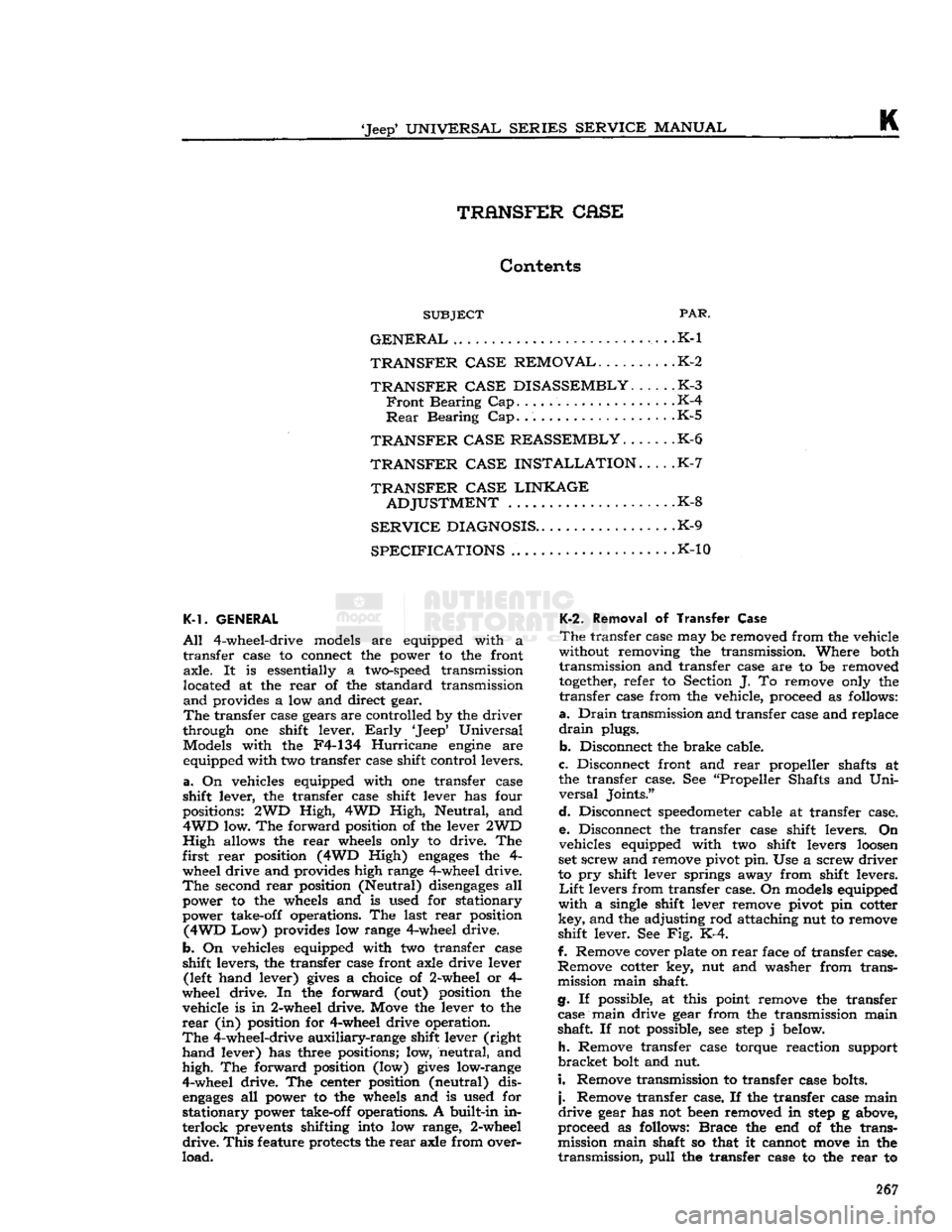
ft
TRANSFER CASE
Contents
SUBJECT
PAR.
GENERAL
. . .K-1
TRANSFER CASE REMOVAL
K-2
TRANSFER CASE DISASSEMBLY
K-3
Front
Bearing Cap K-4
Rear
Bearing Cap K-5
TRANSFER CASE REASSEMBLY.
. .K-6
TRANSFER CASE INSTALLATION
K-7
TRANSFER CASE LINKAGE
ADJUSTMENT
K-8
SERVICE
DIAGNOSIS
K-9
SPECIFICATIONS
.K-10
K-1. GENERAL
All
4-wheel-drive models are equipped with a
transfer
case to connect the power to the front
axle.
It is essentially a
two-speed
transmission
located at the
rear
of the standard transmission
and
provides a low and direct gear.
The
transfer case gears are controlled by the
driver
through
one shift lever.
Early
'Jeep'
Universal
Models with the F4-134
Hurricane
engine
are equipped with two transfer case shift control levers.
a.
On vehicles equipped with one transfer case
shift
lever, the transfer case shift lever has four
positions: 2WD
High,
4WD
High,
Neutral, and
4WD
low. The forward position of the lever 2WD
High
allows the
rear
wheels only to drive. The
first
rear
position (4WD High)
engages
the 4- wheel drive and provides high range 4-wheel drive.
The
second
rear
position (Neutral)
disengages
all power to the wheels and is used for stationary
power take-off operations. The last
rear
position
(4WD
Low) provides low range 4-wheel drive.
b.
On vehicles equipped with two transfer case
shift
levers, the transfer case front axle drive lever (left hand lever)
gives
a choice of 2-wheel or 4-
wheel drive. In the forward (out) position the
vehicle is in 2-wheel drive. Move the lever to the
rear
(in) position for 4-wheel drive operation.
The
4-wheel-drive
auxiliary-range
shift lever (right
hand
lever) has three positions; low, neutral, and
high.
The forward position (low)
gives
low-range
4-wheel drive. The center position (neutral) dis
engages
all power to the wheels and is used for
stationary
power take-off operations. A built-in in
terlock
prevents shifting into low range, 2-wheel
drive.
This
feature protects the
rear
axle from over
load.
K-2.
Removal of
Transfer
Case
The
transfer case may be removed from the vehicle
without removing the transmission. Where both
transmission
and transfer case are to be removed
together,
refer to Section J. To remove only the
transfer
case from the vehicle, proceed as follows:
a.
Drain
transmission
and transfer case and replace
drain
plugs.
b.
Disconnect the brake cable.
c.
Disconnect front and
rear
propeller shafts at
the transfer case. See "Propeller Shafts and
Uni
versal
Joints."
d.
Disconnect
speedometer
cable at transfer case. e. Disconnect the transfer case shift levers. On
vehicles equipped with two shift levers
loosen
set screw and remove pivot pin. Use a screw
driver
to pry shift lever springs away from shift levers.
Lift
levers from transfer case. On models equipped
with
a single shift lever remove pivot pin cotter
key,
and the adjusting rod attaching nut to remove
shift
lever. See Fig. K-4.
f. Remove cover plate on
rear
face of transfer case.
Remove
cotter key, nut and washer from trans
mission
main shaft.
g. If possible, at this point remove the transfer case main drive gear from the transmission main
shaft.
If not possible, see
step
j below.
h.
Remove transfer case torque reaction support
bracket
bolt and nut.
i.
Remove transmission to transfer case bolts.
j.
Remove transfer case. If the transfer case main
drive
gear has not been removed in
step
g above,
proceed as follows:
Brace
the end of the trans
mission
main shaft so that it cannot
move
in the
transmission,
pull
the transfer case to the
rear
to 267
Page 268 of 376
TRANSFER
CASE
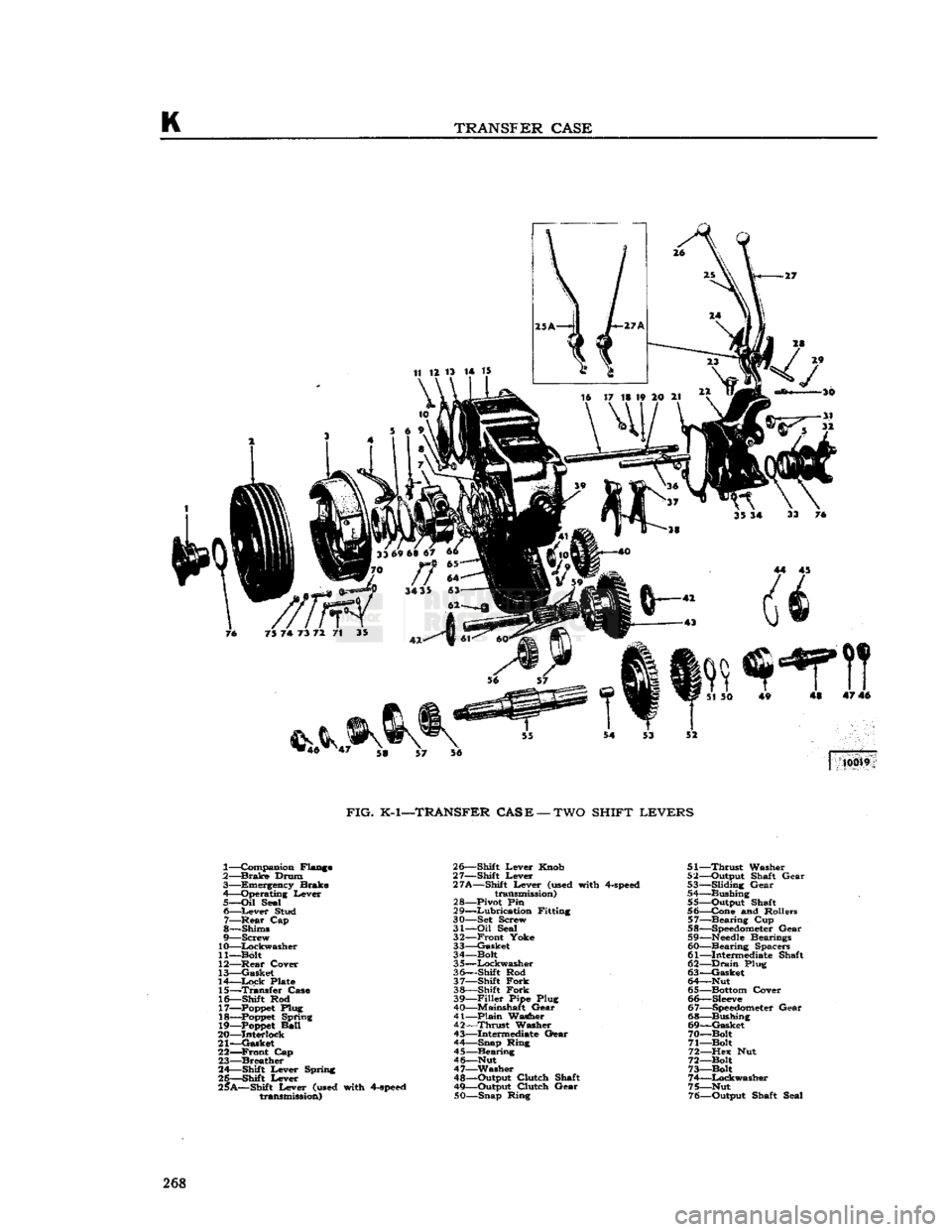
FIG.
K-1—TRANSFER
CASE
—
TWO
SHIFT
LEVERS
1— Companion Flange
2—
Brake
Drum 3— Emergency Brake
4—Operating Lever
5—
Oil
Seal 6—
Lever
Stud 7—
-Rear
Cap
8— Shims
9—
Screw
10—
Lockwasher
11— Bolt
12—
-Rear
Cover
13—
Gasket
14—
Lock
Plate
15—
Transfer
Case
16— Shift Rod 17—
Poppet
Plug
18—Poppet
Spring 19—
Poppet
Ball
20— Interlock
21—Gasket 22—
Front
Cap
23—
Breather
24— Shift Lever Spring
26—Shift
Lever
25*A—Shift Lever
(used
with
4-speed
transmission) 26— Shift Lever Knob
27— Shift Lever
27A—Shift Lever
(used
with
4-speed
transmission)
28—
Pivot
Pin
29—
Lubrication
Fitting
30— Set Screw
31—
Oil
Seal 32—
Front
Yoke
33—
Gasket
34— Bolt
3
5—Lockwasher
36— Shift Rod
37—
Shift
Fork
38— Shift
Fork
39—
Filler
Pipe Plug
40—Mainshaft Gear 41— plain Washer
42—
Thrust
Washer
43—
Intermediate
Gear
44—
Snap Ring
45—
Bearing
46—
Nut 47— Washer
48— Output Clutch Shaft
49—
Output Clutch Gear
50— Snap Ring 51—
Thrust
Washer
52— Output Shaft Gear
53— Sliding Gear
54— Bushing
55— Output Shaft
56— Cone and Rollers
57—
Bearing
Cup
58—
Speedometer
Gear 59—
Needle
Bearings 60—Bearing Spacers
61—
Intermediate
Shaft
62—
Drain
Plug 63—
Gasket
64—Nut
65—
Bottom
Cover
66—
Sleeve
67—
Speedometer
Gear 68— Bushing
69—
Gasket
70— Bolt
71—Bolt
72—
Hex Nut
72— Bolt
73— Bolt
74—
Lockwasher
75— Nut
76— Output Shaft Seal 268
Page 269 of 376
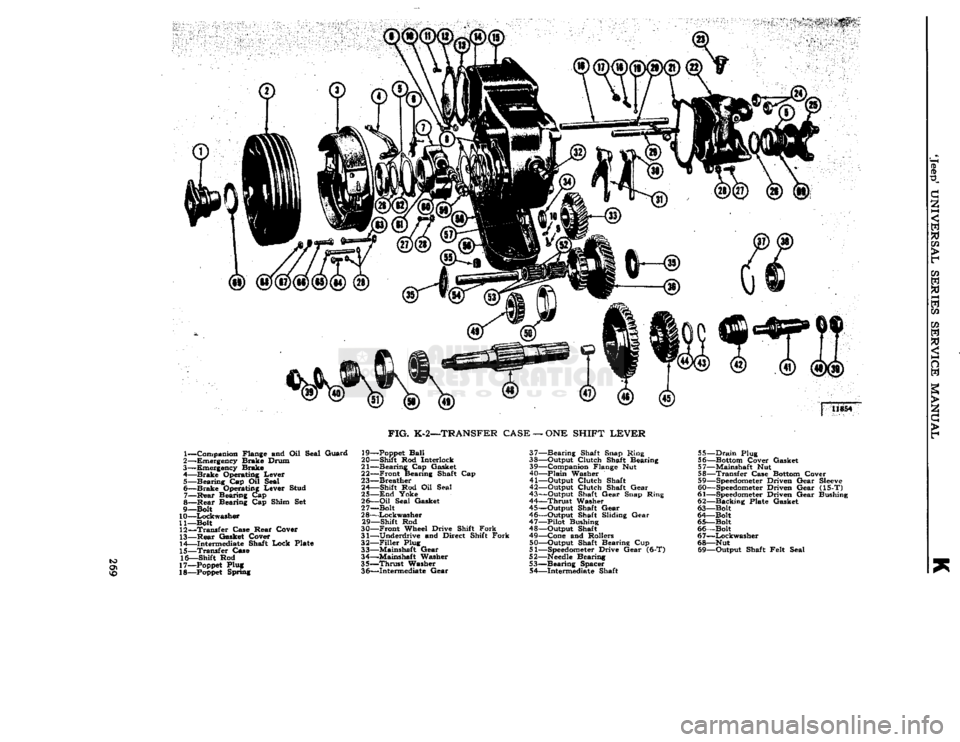
FIG.
K-2—TRANSFER CASE
— ONE
SHIFT
LEVER
1— Companion Flange and Oil Seal
Guard
2— Emergency Brake Drum
3— Emergency Brake 4—
Brake
Operating Lever
5—
Bearing
Cap Ofl Seal 6—
Brake
Operating Lever Stud 7—
Rear
Bearing Cap
8—
Rear
Bearing Cap Shim Set
9— Bolt
10—
Lockwasher
11— Bolt 12—
Transfer
Case Hear Cover
13—
Rear
Gasket Cover 14—
Intermediate
Shaft
Lock
Plate
15—
Transfer
Case
1G—Shift
Rod
17—
Poppet
Plug
18—
Poppet
Spring 19—
Poppet
Ball
20— Shift Rod Interlock
21—
Bearing
Cap Gasket
22—
Front
Bearing Shaft Cap
23—
Breather
24— Shift Rod Oil Seal
25—
End
Yoke
26—
Oil
Seal Gasket
27— Bolt
2 8—Lockwasher 29— Shift Rod
30—
Front
Wheel Drive Shift
Fork
31— Underdrive and Direct Shift
Fork
32—
Filler
Plug 33— Mainshaft
Gear
34— Mainshaft Washer 35—
Thrust
Washer
36—
Intermediate
Gear
37—
Bearing
Shaft Snap Ring
38— Output Clutch Shaft Bearing
39— Companion Flange Nut
40—
Plain
Washer
41— Output Clutch Shaft
42— Output Clutch Shaft
Gear
43— Output Shaft
Gear
Snap Ring
44—
Thrust
Washer
45— Output Shaft
Gear
46— Output Shaft Sliding
Gear
47—
Pilot
Bushing
48— Output Shaft
49— Cone and Rollers 50— Output Shaft Bearing Cup
51—
Speedometer
Drive
Gear
(6-T)
52—
Needle
Bearing 53—
Bearing
Spacer 54—
Intermediate
Shaft 55—
Drain
Plug
56—
Bottom
Cover Gasket
57— Mainshaft Nut
58—
Transfer
Case
Bottom
Cover
59—
Speedometer
Driven
Gear
Sleeve
60—
Speedometer
Driven
Gear
(15-T)
61—
Speedometer
Driven
Gear
Bushing
62—
Backing
Plate
Gasket
63— Bolt
64— Bolt
65— Bolt
66— Bolt
67—
Lockwasher
68— Nut 69— Output Shaft Felt Seal
Page 293 of 376
'Jeep*
UNIVERSAL
SERIES
SERVICE
MANUAL
N
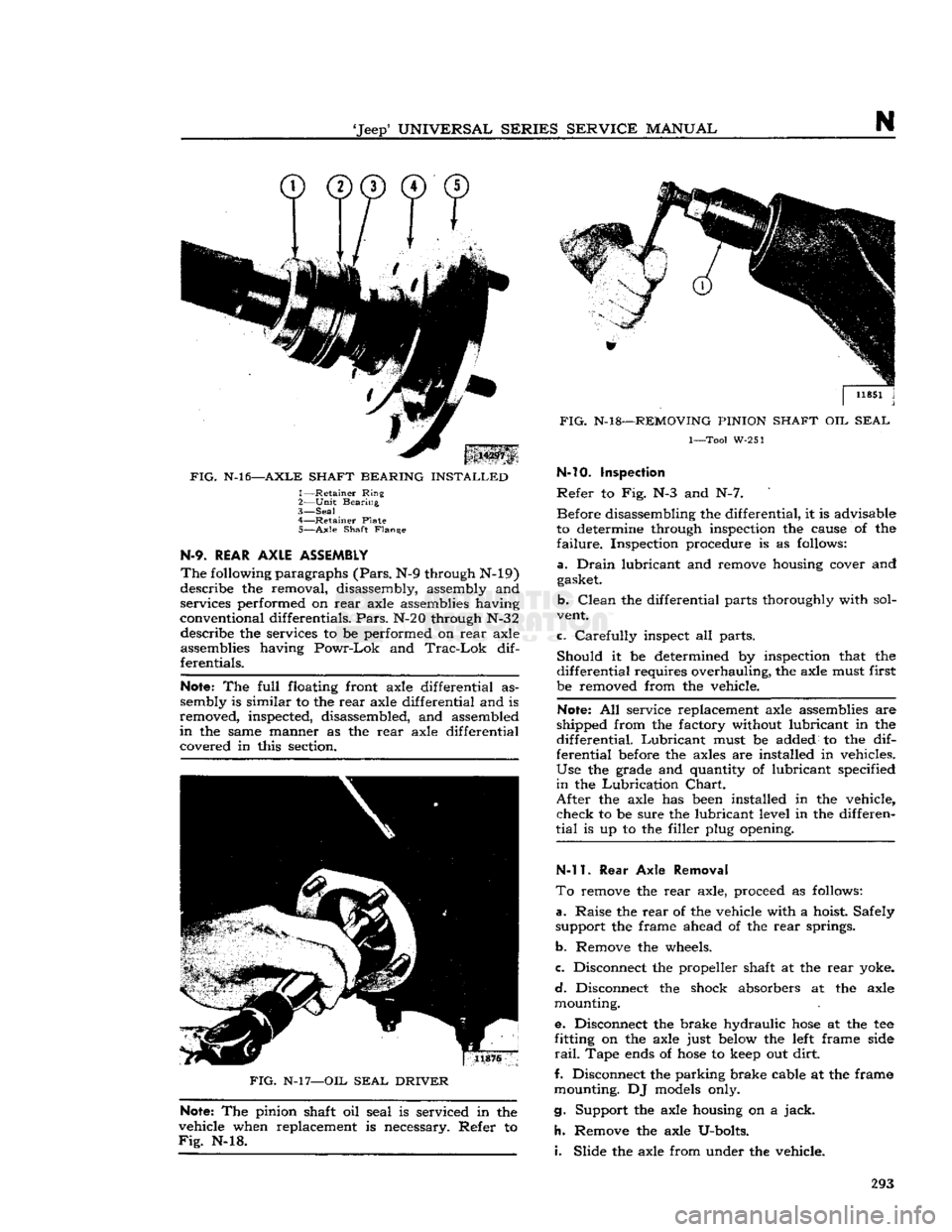
FIG.
N-l6—AXLE
SHAFT
BEARING
INSTALLED
1—
Retainer
Ring
2—
Unit
Bearing
3—
Seal
4—
Retainer
Plate
5—
Axle
Shaft
Flange
N-9.
REAR
AXLE
ASSEMBLY
The
following
paragraphs
(Pars.
N-9 through N-19)
describe the removal, disassembly, assembly and
services performed on
rear
axle assemblies having
conventional differentials.
Pars.
N-20 through N-32 describe the services to be performed on
rear
axle
assemblies having
Powr-Lok
and
Trac-Lok
dif
ferentials.
Note:
The
full
floating front axle differential as
sembly is similar to the
rear
axle differential and is
removed, inspected, disassembled, and assembled
in
the same manner as the
rear
axle differential
covered in this section.
FIG.
N-l
7—OIL
SEAL
DRIVER
Note:
The pinion shaft oil seal is serviced in the
vehicle when replacement is necessary. Refer to
Fig.
N-l8.
11851
j
J
FIG.
N-l8—REMOVING
PINION
SHAFT
OIL
SEAL
1—Tool
W-251 N-10. Inspection
Refer
to Fig. N-3 and N-7. Before disassembling the differential, it is advisable
to determine through inspection the cause of the
failure.
Inspection procedure is as follows:
a.
Drain
lubricant and remove housing cover and gasket.
b.
Clean
the differential parts thoroughly with sol
vent.
c.
Carefully
inspect all parts.
Should
it be determined by inspection that the
differential
requires overhauling, the axle must first
be removed from the vehicle.
Note:
All service replacement axle assemblies are
shipped from the factory without lubricant in the
differential.
Lubricant
must be added to the dif
ferential
before
the axles are installed in vehicles.
Use
the grade and quantity of lubricant specified
in
the
Lubrication
Chart.
After
the axle has
been
installed in the vehicle,
check
to be sure the lubricant level in the differen
tial
is up to the filler plug opening.
N-l
1.
Rear
Axle Removal
To
remove the
rear
axle, proceed as follows:
a.
Raise the
rear
of the vehicle with a hoist. Safely
support the frame ahead of the
rear
springs.
b.
Remove the wheels.
c.
Disconnect the propeller shaft at the
rear
yoke.
d.
Disconnect the shock absorbers at the axle
mounting.
e. Disconnect the brake hydraulic
hose
at the tee
fitting on the axle just
below
the
left
frame side
rail.
Tape
ends
of
hose
to
keep
out
dirt.
f. Disconnect the parking brake cable at the frame
mounting. DJ
models
only.
g. Support the axle housing on a
jack.
h.
Remove the axle U-bolts.
i.
Slide the axle from under the vehicle. 293
Page 362 of 376

u
MISCELLANEOUS
U-12.
STANDARD
AND
RECOMMENDED TOOLS
(Continued)
Tool
Description
CLUTCH
W-296 Fixture — Adjusting
TRANSMISSION
C-3201
- A
Lo-Jack
— Floor Type
AXLE
C-637 Puller — Axle Shaft & Oil Seal
STEERING
DD-428 Gauge — Camber & Caster
DD-435 Turntables — Wheel Alignment C-3479 Gauge & Scribe — Toe-in Checking
BRAKES
C-416 Clamps — Brake Cylinder Retaining C-3080 Hone — Brake Cylinder
C-3496-B Bleeder — Hydraulic Pressure Type C-3785 Remover & Installer — Brake Return Spring
C-3920 Micrometer — Brake Drum Checking
U-13.
ENGINE TORQUE SPECIFICATIONS HURRICANE
F4
ENGINE
Pounds - Feet
kg-m.
30-40
4,1
a
5,5
Camshaft
Thrust Plate Bolt
20-26
2,8
a
3,6
Clutch
Control
Ball
Stud — [7,93 mm.]
35-45
4,8
a
6,2
Connecting Rod Cap Bolt Nut — y8" [9,53 mm.|
35-45
4,8
a
6,2
60-70
8,3
a
9,7
Cylinder
Head to Block Bolts
60-70
8,3
a
9,7
45-55
6,2
a
7,6
29-35
4,0
a
4,8
Flywheel
to Crankshaft Bolt. 35-41
4,8
a
5,7
Fuel
Pump Mounting Bolts 13-17 1,8
a
2,4
Alternator Bracket to Cylinder Block.
25-35
3,5
a
4,8
29-35
4,0
a
4,8
Main
Bearing
Caps.
.
65-75
9,0
a
10,4
Oil
Pan
Drain
Plug
25-35
3,5
a
4,8
9-14 1,2
a
1,9
Piston Pin
Lock
Bolt 35-41
4,8
a
5,7
30-36
4,1
a
5,0
Spark
Plugs to Cylinder Head
25-33
3,5
a
4,6
Starting Motor Mounting Bolt.
20-25
2,8
a
3,5
7-10 0,9
a
1,4
Water
Outlet Elbow to Cylinder Head
20-25
2,8
a
3,5
Water
Pump to Cylinder Block 12-17
1,7
a
2,4
NOTE:
Turn
the connecting rod cap nut locks (inverted type, pressed
steel)
finger
tight
and then
tighten
% turn more with wrench
362