1953 JEEP CJ ECU
[x] Cancel search: ECUPage 292 of 376
N
REAR
AXLE
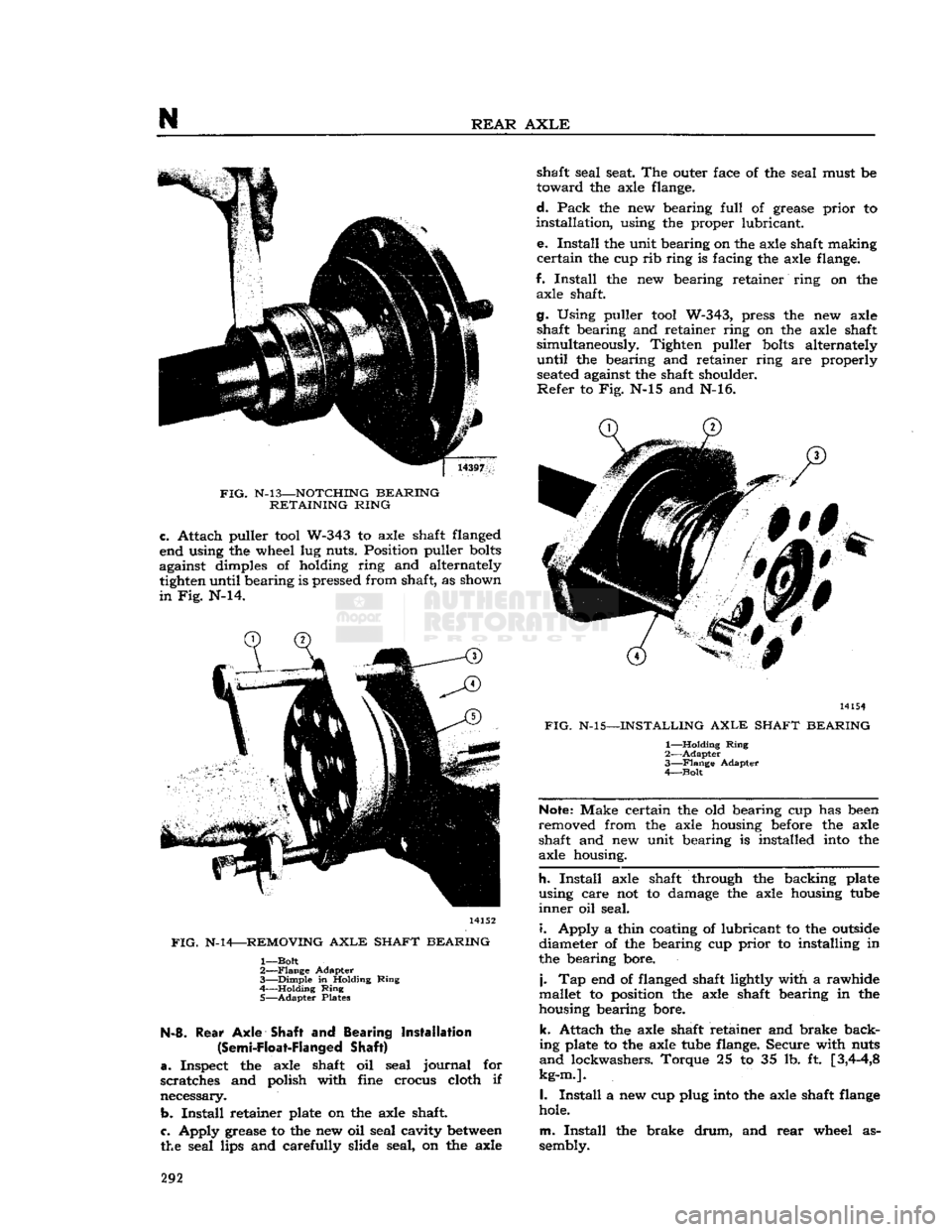
FIG.
N-l3—NOTCHING
BEARING
RETAINING
RING
c.
Attach puller
tool
W-343 to axle shaft flanged
end using the wheel lug nuts. Position puller
bolts
against dimples of holding ring and alternately tighten until bearing is pressed from shaft, as shown
in
Fig. N-14. 14152
FIG.
N-14—REMOVING
AXLE
SHAFT
BEARING
1—
Bolt
2—
Flange
Adapter
3—
Dimple
in Holding
Ring
4 Holding
Ring
5—
Adapter
Plates N-8.
Rear
Axle
Shaft and Bearing Installation
(Semi-Float-Flanged
Shaft)
a.
Inspect the axle shaft oil seal
journal
for
scratches and polish with fine crocus cloth if
necessary.
b.
Install
retainer plate on the axle shaft
c.
Apply grease to the new oil seal cavity
between
the seal lips and carefully slide seal, on the axle shaft seal seat. The outer face of the seal must be
toward
the axle flange.
d.
Pack
the new bearing
full
of grease
prior
to
installation,
using the proper lubricant.
e.
Install
the unit bearing on the axle shaft making
certain
the cup rib ring is facing the axle flange.
f.
Install
the new bearing retainer ring on the axle shaft.
g. Using puller
tool
W-343, press the new axle shaft bearing and retainer ring on the axle shaft
simultaneously. Tighten puller
bolts
alternately
until
the bearing and retainer ring are properly
seated
against the shaft shoulder.
Refer
to Fig. N-15 and N-16. 14154
FIG.
N-15—INSTALLING
AXLE
SHAFT
BEARING
1—
Holding
Ring
2—
Adapter
3—
Flange
Adapter
4—
Bolt
Note:
Make certain the old bearing cup has
been
removed from the axle housing
before
the axle
shaft and new unit bearing is installed
into
the
axle housing.
h.
Install
axle shaft through the backing plate
using care not to damage the axle housing
tube
inner
oil seal.
i.
Apply a thin coating of lubricant to the
outside
diameter of the bearing cup
prior
to installing in
the bearing bore.
j.
Tap end of flanged shaft lightly with a rawhide
mallet to position the axle shaft bearing in the
housing bearing bore.
k.
Attach the axle shaft retainer and brake back
ing plate to the axle
tube
flange. Secure with nuts
and
lockwashers. Torque 25 to 35 lb. ft
[3,4-4,8
kg-m.].
I.
Install
a new cup plug
into
the axle shaft
flange
hole.
m.
Install
the brake
drum,
and
rear
wheel as
sembly. 292
Page 314 of 376
STEERING
SYSTEM
O-L
GENERAL
The
steering system on all Jeep Universal vehicles
consists of the steering gear, steering wheel, steering column and shaft, and steering linkage.
This
section covers wheel alignment, steering linkage,
steering gear, steering column and steering wheel.
0-2. Steering
Gear
Function
The
steering gear is a reducing gear. It exchanges a
relatively
large amount of movement with a small force (applied by the driver at the steering wheel), for a much smaller amount of movement with a
greatly increased force through a cam and lever
action type steering gear. The steering gear ratio is 17.9 to 1 on vehicles equipped with the F4
engine
and
19 to 1 with the V6 engine.
0-3. Steering
Linkage
Refer
to Fig. O-l.
The
steering linkage consists of a steering arm at
tached to the steering gear, a steering connecting
rod,
(drag
link),
connecting the steering arm to the
beilcrank,
and a steering tie rod connecting the
beilcrank
to the axle tie rod. The beilcrank pivots
on a pin mounted just to the left of the frame front crossmember. The steering tie rod is connected to
the beilcrank and
extends
to the right
ball
joint as sembly of tie rod. The tie rod
extends
to the wheels,
being connected to their respective steering knuckle
arms
at the wheels.
With
this linkage arrangement,
as the steering arm
moves
rearward,
the front
wheels
turn
to the left. As the steering arm
moves
forward,
the wheels
turn
to the right.
Ball
joints are used to secure the drag
link,
steering
connecting rod and tie rod ends. The
ball
joints
assist in maintaining
good
steering control and con
stant toe-in of the front wheels under all driving conditions. If the
ball
joints
become
worn enough
to allow free motion in the linkage, they should be,
replaced.
Note:
Ball
joint replacement of the tie rod requires
resetting of the wheel toe-in adjustment.
0-4.
Steering
Column
and Gear
Alignment
When
adjusting a steering gear remove all loads
from
the unit by disconnecting the steering con
necting rod (drag
link)
from the steering arm and
also
loosen
the instrument panel bracket and the
steering gear to frame
bolts
to allow the steering
post
to correctly align itself. When retightening the
steering gear to frame
bolts
use a torque wrench
pull
of 45 to 55 lb-ft. [6,2 a 7,6 kg-m.] on the
Vk*
bolts
and 30 to 40 lb-ft. [4,15 a 5,5 kg-m.] on the
Vs"
bolts. 10811
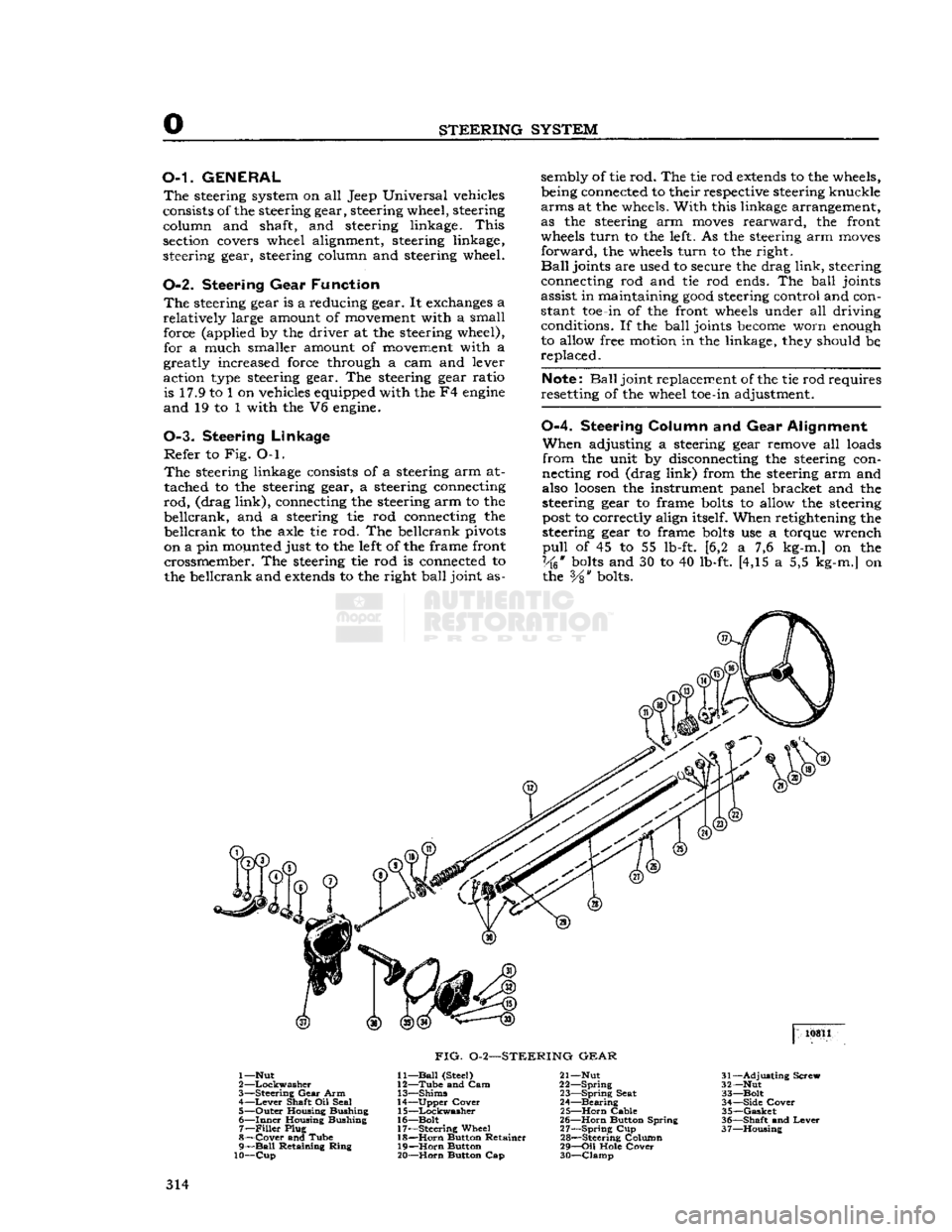
FIG.
0-2—STEERING
GEAR
1—Nut
2
—Lockwasher
3—
Steering
Gear
Arm 4—
Lever
Shaft Oil Seal
5—
Outer
Housing Bushing
6—
Inner
Housing Bushing 7—
Filler
Plug
8—
Cover
and Tube
9—
Ball
Retaining
Ring
10—Cup
11—
Ball
(Steel)
12—
Tube
and Cam
13—
Shims
14—
Upper
Cover
15—
Lockwasher
16—
Bolt
17—
Steering
Wheel 18—
Horn
Button Retainer
19—
Horn
Button
20—
Horn
Button Cap 21— Nut
22—
Spring
23—
Spring
Seat
24—
Bearing
25—
Horn
Cable
26—
Horn
Button Spring
27—
Spring
Cup
28—
Steering Column
29—
Oil
Hole
Cover
30—
Clamp
31—
Adjusting
Screw
32— Nut
33—
Bolt
34—
Side
Cover
35—
Gasket
36—
Shaft
and
Lever
37—
Housing
314
Page 317 of 376
'Jeep'
UNIVERSAL SERIES SERVICE
MANUAL
The
purpose of caster Fig. O-S, is to provide steer
ing stability which
will
keep the front wheels in the
straight
ahead position and also assist in straighten
ing up the wheels when coming out of a
turn.
Caster
of the front wheels is preset. If the angle of
caster,
when accurately measured, is found to be
incorrect,
correct it to the specification given at
the end of this section by either installing new
parts
or installing caster shims
between
the axle
pad
and the springs.
If
the camber and toe-in are correct and it is known
the the axle is not twisted, a satisfactory check
may
be made by testing the vehicle on the road.
Before road testing, make sure all tires are properly
inflated,
being particularly careful that both front
tires are inflated to exactly the same pressure.
If
vehicle turns easily to either side but is
hard
to
straighten out, insufficient caster for easy handling of vehicle is indicated. If correction is necessary, it
can
usually be accomplished by installing shims
between
the springs and axle pads to secure the
desired
result.
0-11-
Front
Wheel
Turning
Angle
When
the front wheels are turned, the inside wheel
on the
turn
travels in a smaller circle than the outside wheel, therefore, it is necessary for the wheels
to toe out to prevent the tire on the inside wheel
frOm
being scuffed sideways.
This
angle for toe out
on turns is designed to permit both front wheels to
turn
on a common center by having the ends of the
steering
knuckle
arms closer
together
than the king
pins.
To
avoid possible damage to the universal joints
on the front axles of 4-wheel drive vehicles, it is advisable to check the turning angle.
Wearing
away
of the upset
edge
on the spindle housing bolt which
10607
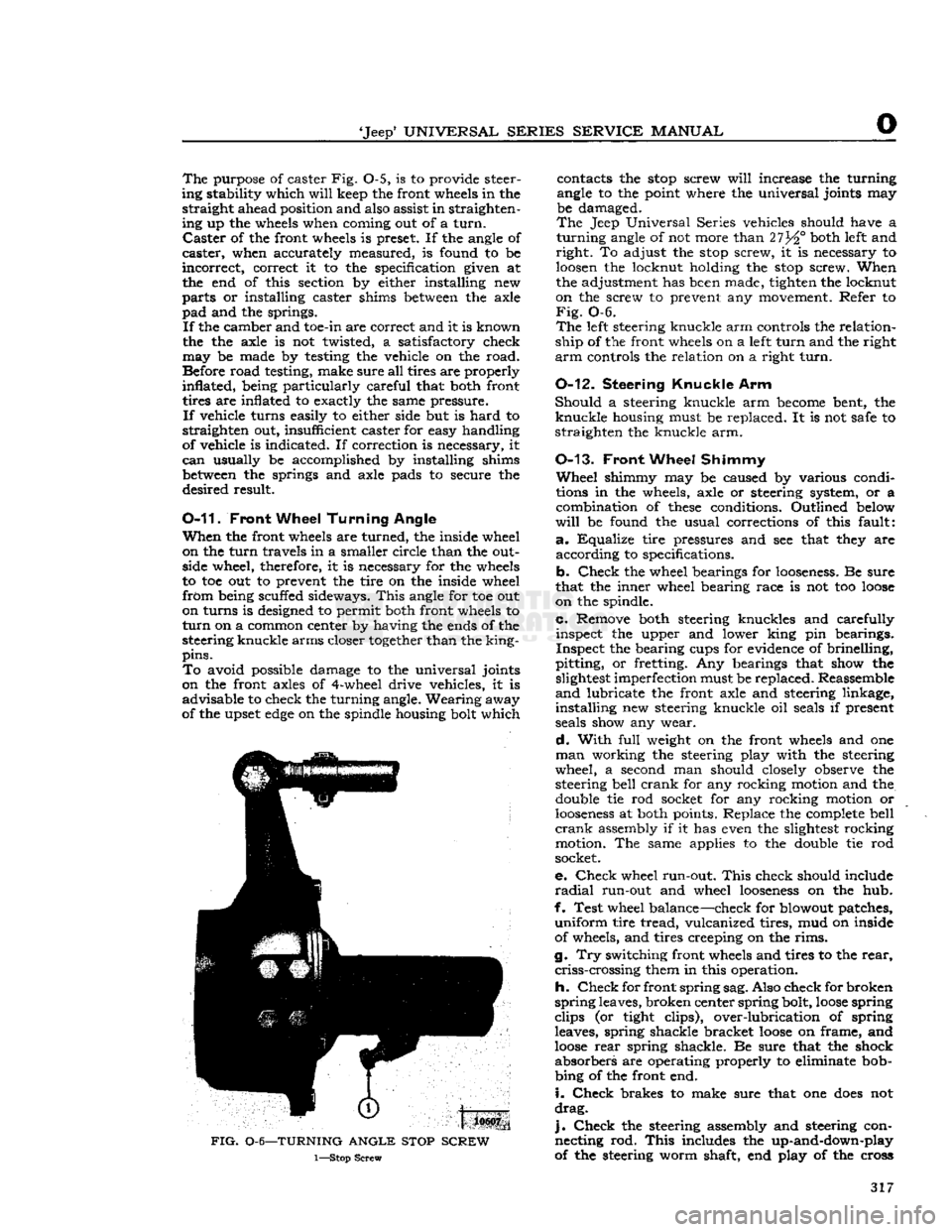
FIG.
0-6—TURNING
ANGLE
STOP
SCREW
1—Stop
Screw
contacts the
stop
screw
will
increase the turning
angle to the point where the universal joints may
be damaged.
The
Jeep Universal Series vehicles should have a
turning
angle of not more than 27^° both left and
right.
To adjust the
stop
screw, it is necessary to
loosen
the locknut holding the
stop
screw. When
the adjustment has been made, tighten the locknut
on the screw to prevent any movement. Refer to
Fig.
O 6.
The
left steering knuckle arm controls the relation
ship of the front wheels on a left
turn
and the right
arm
controls the relation on a right
turn.
0-12. Steering
Knuckle
Arm
Should
a steering knuckle arm
become
bent, the
knuckle
housing must be replaced. It is not safe to
straighten the knuckle arm.
0-13.
Front
Wheel
Shimmy
Wheel
shimmy may be caused by various condi
tions in the wheels, axle or steering system, or a
combination of
these
conditions. Outlined below
will
be found the usual corrections of this fault:
a.
Equalize
tire pressures and see that they are
according
to specifications.
b.
Check
the wheel bearings for
looseness.
Be sure
that the inner wheel bearing race is not too
loose
on the spindle.
c.
Remove both steering knuckles and carefully inspect the upper and lower king pin bearings.
Inspect
the bearing cups for evidence of brinelling,
pitting, or fretting. Any bearings that show the slightest imperfection must be
replaced.
Reassemble
and
lubricate the front axle and steering linkage,
installing
new steering knuckle oil seals if present
seals show any wear.
d.
With
full
weight on the front wheels and one
man
working the steering play with the steering
wheel, a second man should closely observe the steering bell
crank
for any rocking motion and the
double tie rod socket for any rocking motion or
looseness
at both points. Replace the complete bell
crank
assembly if it has even the slightest rocking motion. The same applies to the double tie rod
socket.
e.
Check
wheel run-out.
This
check should include
radial
run-out and wheel
looseness
on the hub.
f- Test wheel balance—check for blowout patches,
uniform
tire tread, vulcanized tires, mud on inside
of wheels, and tires creeping on the
rims.
g.
Try
switching front wheels and tires to the
rear,
criss-crossing
them in this operation.
h.
Check
for front
spring
sag. Also check for broken
spring
leaves, broken center
spring
bolt,
loose
spring
clips
(or tight clips), over-lubrication of spring leaves, spring shackle bracket
loose
on frame, and
loose
rear
spring shackle. Be sure that the shock
absorbers
are operating properly to eliminate bobbing of the front end.
i.
Check
brakes to make sure that one
does
not
drag.
j.
Check
the steering assembly and steering con necting rod.
This
includes the up-and-down-play
of the steering worm shaft, end play of the cross 317
Page 326 of 376
p
BRAKES
be either a defective master cylinder or the use of
low grade brake fluid which has expanded because
of heat. Use standard duty brake fluid conforming to
SAE-J1703
specification.
P-7.
Bleeding
Brakes
The
hydraulic
brake system must be bled whenever
a
fluid line has been disconnected or air
gets
into the system. A leak in the system may sometimes
be indicated by the presence of a spongy brake
pedal.
Air trapped in the system is compressible
and
does
not permit the pressure, applied to the
brake
pedal, to be transmitted solidly through to
the brakes. The system must be absolutely free
from
air at all times. When bleeding brakes, bleed
at that wheel with the
longest
line from the master
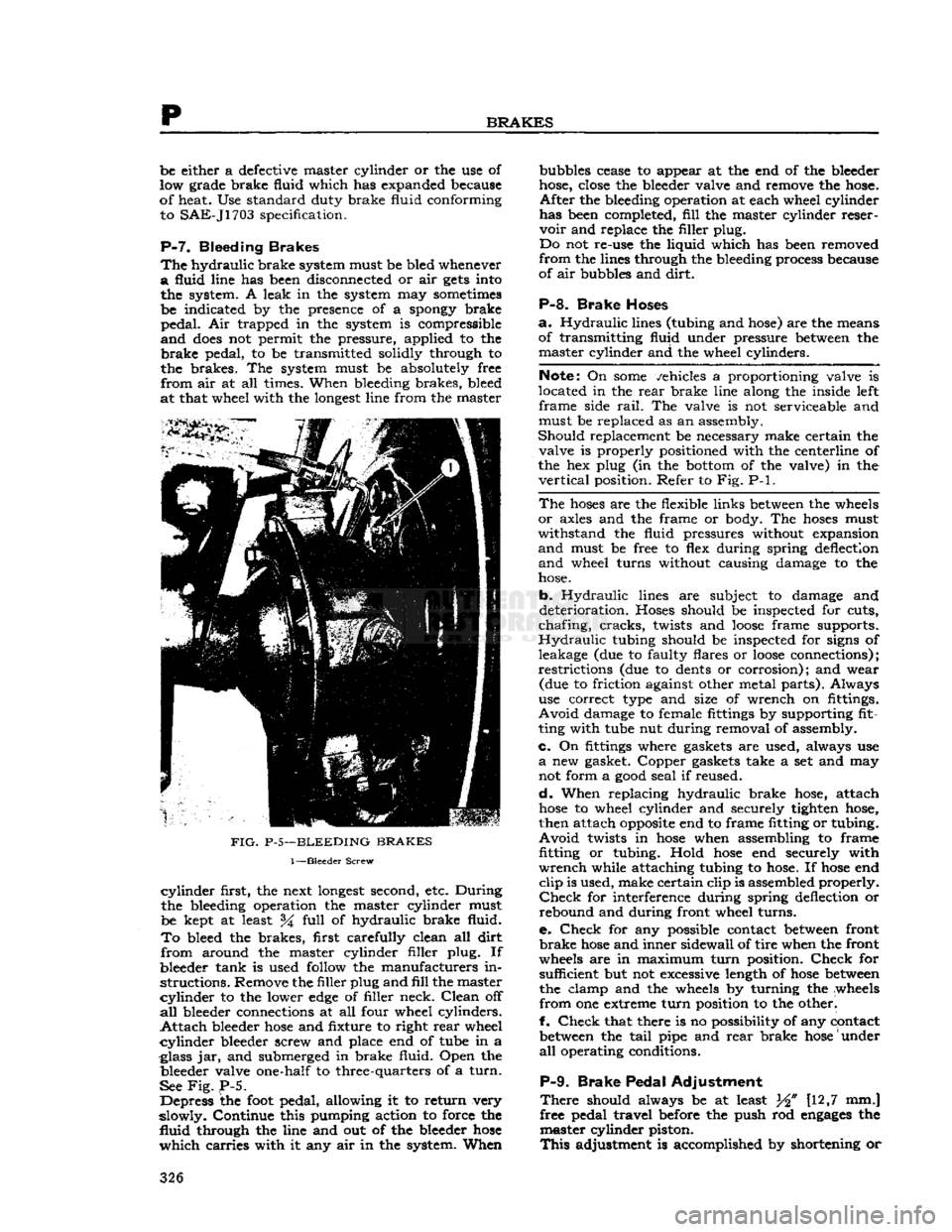
FIG.
P-5—BLEEDING
BRAKES
1—Bleeder
Screw
cylinder
first, the next
longest
second, etc. During
the bleeding operation the master cylinder must
be kept at least %
full
of hydraulic brake fluid.
To
bleed the brakes, first carefully clean all
dirt
from
around the master cylinder filler plug. If
bleeder tank is used follow the manufacturers in
structions.
Remove the filler plug and
fill
the master
cylinder
to the lower
edge
of filler neck.
Clean
off
all
bleeder connections at all four wheel cylinders.
Attach
bleeder
hose
and fixture to right
rear
wheel
cylinder
bleeder screw and place end of tube in a
glass jar, and submerged in brake fluid. Open the bleeder valve one-half to three-quarters of a
turn.
See
Fig.
P-5.
Depress the
foot
pedal, allowing it to return very
slowly. Continue this pumping action to force the
fluid
through the line and out of the bleeder
hose
which
carries with it any air in the system. When bubbles cease to appear at the end of the bleeder
hose, close the bleeder valve and remove the hose.
After
the bleeding operation at each wheel cylinder
has been completed,
fill
the master cylinder reser
voir
and replace the filler plug.
Do not re-use the liquid which has been removed
from
the lines through the bleeding process because
of air bubbles and
dirt.
P-8.
Brake Hoses
a.
Hydraulic
lines (tubing and hose) are the means
of transmitting fluid under pressure between the master cylinder and the wheel cylinders.
Note:
On
some
vehicles a proportioning valve is
located in the
rear
brake line along the inside left
frame
side
rail.
The valve is not serviceable and
must be replaced as an assembly.
Should
replacement be necessary make certain the valve is properly positioned with the centerline of
the hex plug (in the bottom of the valve) in the
vertical
position. Refer to Fig. P-l.
The
hoses
are the flexible links between the wheels
or
axles and the frame or body. The
hoses
must
withstand
the fluid pressures without expansion
and
must be free to flex during spring deflection
and
wheel turns without causing damage to the
hose.
b.
Hydraulic
lines are subject to damage and
deterioration. Hoses should be inspected for cuts,
chafing,
cracks,
twists and
loose
frame supports.
Hydraulic
tubing should be inspected for signs of
leakage (due to faulty flares or
loose
connections);
restrictions
(due to dents or corrosion); and wear (due to friction against other metal parts). Always
use correct type and size of wrench on fittings.
Avoid
damage to female fittings by supporting fit
ting with tube nut during removal of assembly.
c.
On fittings where gaskets are used, always use
a
new gasket. Copper gaskets take a set and may
not form a
good
seal if reused.
d.
When replacing hydraulic brake hose, attach
hose
to wheel cylinder and securely tighten hose,
then attach
opposite
end to frame fitting or tubing.
Avoid
twists in
hose
when assembling to frame fitting
or
tubing. Hold
hose
end securely with
wrench
while attaching tubing to hose. If
hose
end
clip
is used, make certain clip is assembled properly.
Check
for interference during spring deflection or
rebound and during front wheel turns.
e.
Check
for any possible contact between front
brake
hose
and inner sidewall of tire when the front
wheels are in maximum
turn
position.
Check
for sufficient but not excessive length of
hose
between
the clamp and the wheels by turning the wheels
from
one extreme
turn
position to the otherl
f.
Check
that there is no possibility of any contact between the
tail
pipe and
rear
brake
hose
under
all
operating conditions.
P-9.
Brake Pedal Adjustment
There
should always be at least W [12,7 mm.]
free pedal travel before the push rod
engages
the master cylinder piston.
This
adjustment is accomplished by shortening or 326
Page 327 of 376
'Jeep'
UNIVERSAL
SERIES SERVICE
MANUAL
P
lengthening of the brake master cylinder eye bolt.
This
is
done
so the primary cup
will
clear the by
pass port when the piston is in the off position,
otherwise the compensating action of the master
cylinder
for expansion and contraction of the fluid
in
the system, due to temperature changes,
will
be destroyed and cause the brakes to drag.
Note:
Some older 'Jeep' vehicles may
develop
side
movement
of the clutch and brake pedals resulting
from wear of the pedals, shafts, and bushings. One
way to
compensate
for this wear is to install a pedal
slack
adjuster kit,
Part
No.
921936.
FIG.
P-6—HAND
BRAKE
ADJUSTMENT
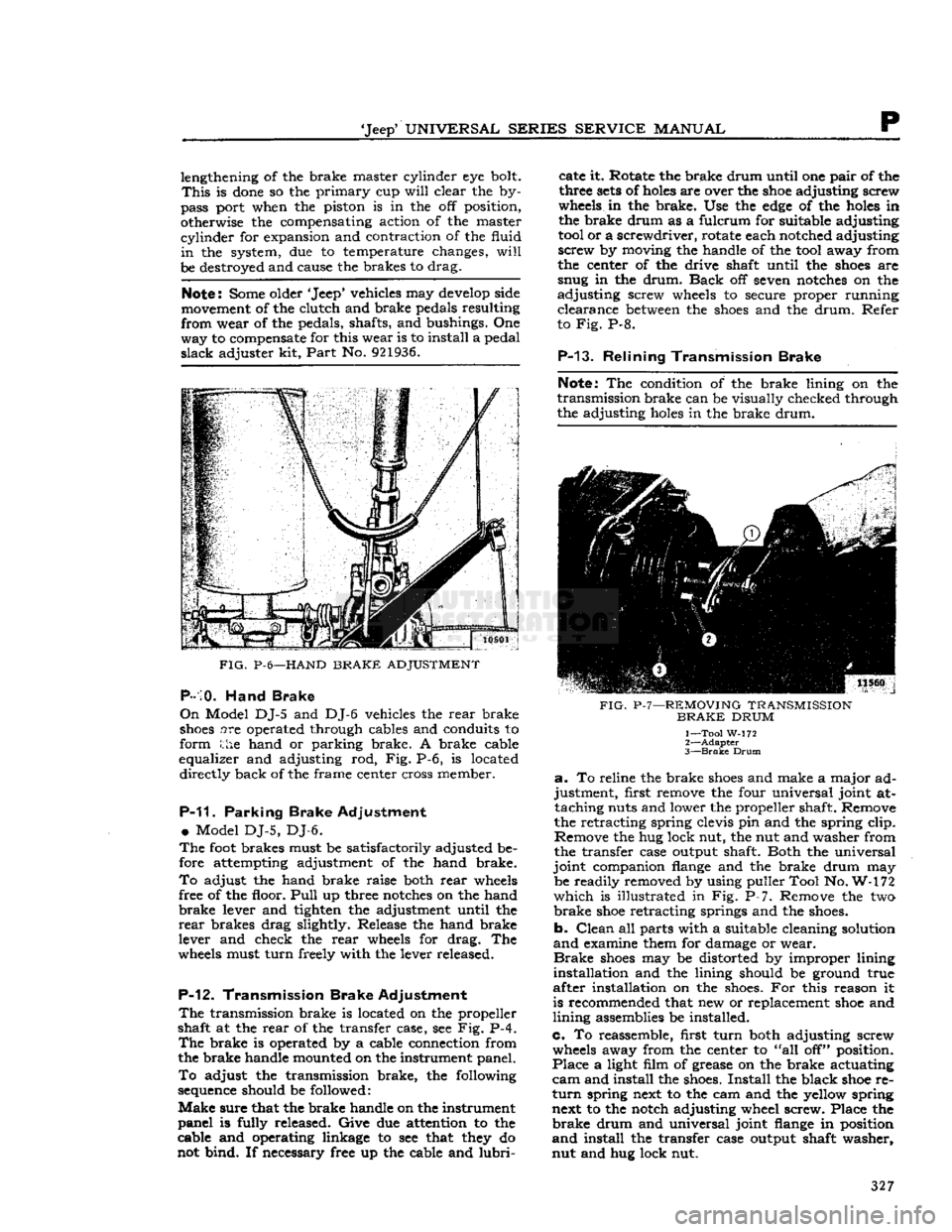
P-10.
Hand Brake
On
Model DJ-5 and DJ-6 vehicles the rear brake
shoes
are operated through cables and conduits to
form the hand or parking brake. A brake cable
equalizer and adjusting rod, Fig. P-6, is located directly back of the frame center cross member.
P-11.
Parking Brake Adjustment
•
Model DJ-5, DJ-6.
The
foot
brakes must be satisfactorily adjusted be
fore attempting adjustment of the hand brake.
To
adjust the hand brake raise both rear
wheels
free of the floor.
Pull
up three
notches
on the hand
brake
lever and tighten the adjustment until the
rear
brakes drag slightly. Release the hand brake
lever and check the rear
wheels
for drag. The
wheels
must turn freely with the lever released.
P-12.
Transmission Brake Adjustment
The
transmission brake is located on the propeller
shaft at the rear of the transfer case, see Fig. P-4.
The
brake is operated by a cable connection from
the brake handle mounted on the instrument panel.
To
adjust the transmission brake, the following
sequence
should be followed:
Make
sure that the brake handle on the instrument
panel is fully released. Give due attention to the
cable and operating linkage to see that
they
do
not bind. If necessary free up the cable and
lubri
cate it. Rotate the brake drum until one pair of the
three
sets
of
holes
are over the
shoe
adjusting screw
wheels
in the brake. Use the
edge
of the
holes
in
the brake drum as a fulcrum for suitable adjusting
tool
or a screwdriver, rotate each notched adjusting
screw by moving the handle of the
tool
away from
the center of the drive shaft until the
shoes
are
snug in the drum.
Back
off seven
notches
on the
adjusting screw
wheels
to secure proper running clearance
between
the
shoes
and the drum. Refer
to Fig. P-8.
P-13.
Relining Transmission Brake
Note:
The condition of the brake lining on the
transmission brake can be visually checked through
the adjusting
holes
in the brake drum.
FIG.
P-7—REMOVING
TRANSMISSION
BRAKE
DRUM
1— Tool W-172
2—
Adapter
3—
Brake
Drum
a.
To reline the brake
shoes
and make a major ad
justment, first remove the four universal joint at taching nuts and lower the propeller shaft. Remove
the retracting spring clevis pin and the spring clip.
Remove the hug lock nut, the nut and washer from
the transfer case output shaft. Both the universal
joint companion
flange
and the brake drum may be readily removed by using puller Tool No. W-172
which
is illustrated in Fig. P-7. Remove the two
brake
shoe
retracting springs and the
shoes.
b. Clean all parts with a suitable cleaning solution
and
examine them for damage or wear.
Brake
shoes
may be distorted by improper lining
installation and the lining should be ground true
after installation on the
shoes.
For this reason it
is recommended that new or replacement
shoe
and
lining assemblies be installed.
c. To reassemble, first turn both adjusting screw
wheels
away from the center to "all off" position.
Place a light film of grease on the brake actuating
cam
and install the
shoes.
Install the black
shoe
re
turn
spring next to the cam and the yellow spring next to the notch adjusting wheel screw. Place the
brake
drum and universal joint
flange
in position
and
install the transfer case output shaft washer,
nut and hug lock nut. 327
Page 330 of 376
p
BRAKES
c. To assemble the brake unit, place the
shoes
on
the backing plates and secure with the
shoe
hold
down pin and clip. Place the adjusting lever on the
secondary
shoe
web making sure the
slot
in the lever
engages
to full depth with the
slot
in the
shoe
web. The adjuster levers are painted RED for right hand brakes and
BLUE
for
left
hand brakes.
d.
Install the adjusting screw assemblies. The star
wheel must be installed over the adjusting
hole
in the backing plate.
Notes
Interchanging adjusting screw assemblies
will
cause
shoe
to retract rather than expand.
e. Assemble the lower spring that
fastens
to the
two
shoe
webs.
THE LONG HOOK
END should
be secured in the small
hole
in the secondary
shoe
and
should be
UNDER
the
shoe
web. The short hook end should be secured in the small
hole
in the
primary
shoe.
If the spring is installed correctly,
the long hook end
will
not interfere with either the lever or the star wheel
teeth.
f. Install the anchor block with arrow pointing in the forward direction of the drum rotation. Place the
guide
plate over the anchor pin and using Tool
C-3
785 install the
shoe
return springs (secondary
spring
first) with the long hook end flat against the
guide
plate.
g. Install the lever crank in the small
hole
on the secondary
shoe
web, the
left
lever crank on the left,
and
right lever crank on the right. A
"L"
or
"R"
is
located on the
hexagon
side of the crank for identi
fication.
Make
certain the lever rotates freely on
the
hexagon
head screw.
fi.
Assemble the short wire link with large hook by
first
inserting the "S" shape
offset
end
into
the
lever crank
hole
which is
closest
to the
hexagon
head and then snap the hook end of the link in the top
groove
of the anchor pin.
i.
Insert the long link with "S" shaped end in the
crank
lever.
Lift
the adjuster lever up
enough
to hook the link in the
slot
of the adjusting lever. The
adjusting lever
will
then
engage
the star wheel
teeth
between
M%
[1,59 mm.]
above
or
below
the centerline of adjusting screw assembly,
j.
Lubricate the wheel bearings and install the
brake
drum and adjust the wheel bearing to the proper preload.
k. Adjust the brakes as described in Par. P-19.
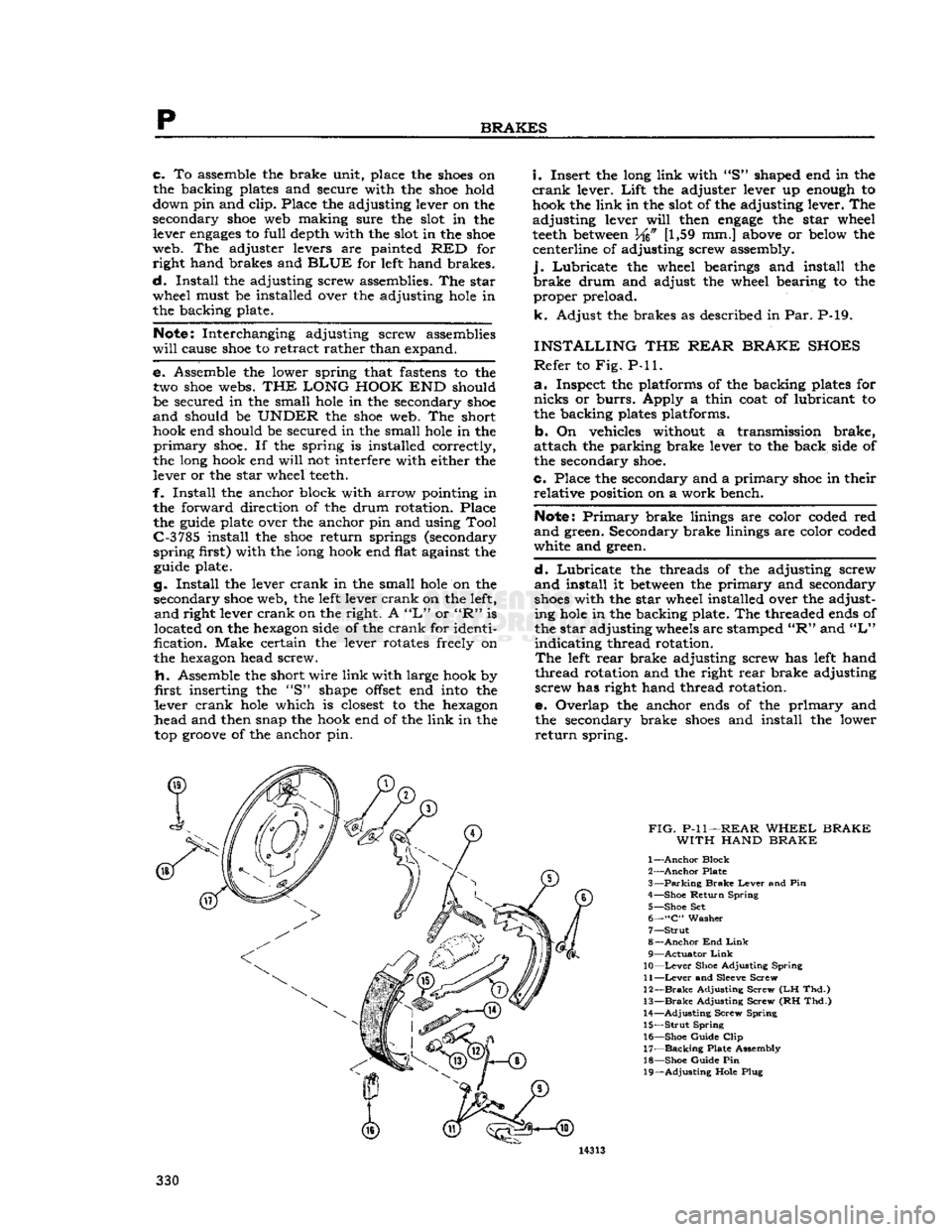
INSTALLING
THE
REAR BRAKE SHOES
Refer
to Fig. P-ll.
a.
Inspect the platforms of the backing plates for
nicks
or
burrs.
Apply a thin coat of lubricant to
the backing plates platforms.
b. On vehicles without a transmission brake,
attach the parking brake lever to the back side of
the secondary
shoe.
c. Place the secondary and a primary
shoe
in their relative position on a work bench.
Note:
Primary
brake linings are color coded red
and
green. Secondary brake linings are color coded
white and green.
d.
Lubricate the threads of the adjusting screw
and
install it
between
the primary and secondary
shoes
with the star wheel installed over the adjusting
hole
in the backing plate. The threaded
ends
of
the star adjusting
wheels
are stamped
"R"
and
"L"
indicating thread rotation.
The
left
rear brake adjusting screw has
left
hand
thread rotation and the right rear brake adjusting screw has right hand thread rotation.
e. Overlap the anchor
ends
of the primary and the secondary brake
shoes
and install the lower
return
spring.
Page 332 of 376
BRAKES
12519
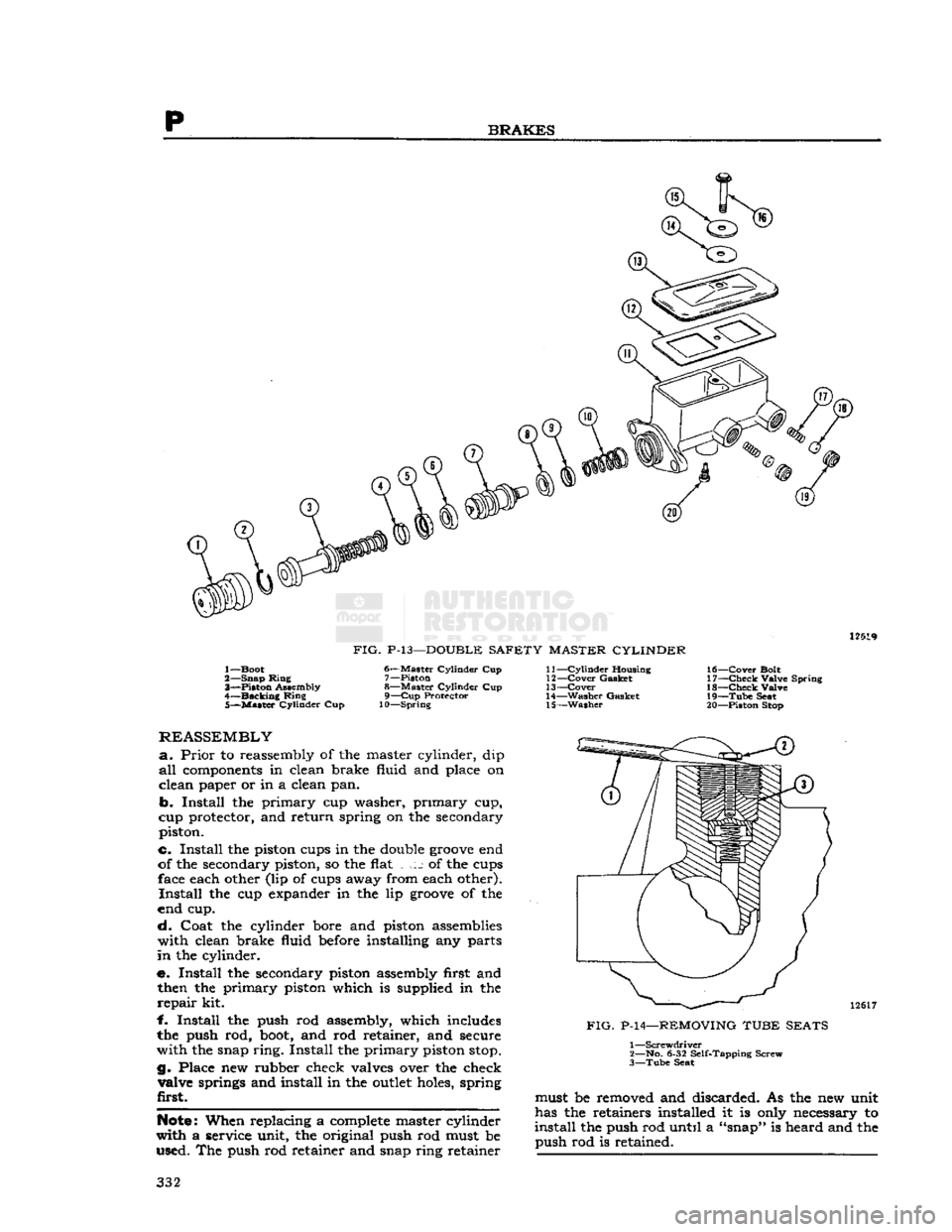
FIG.
P-13—DOUBLE
SAFETY MASTER CYLINDER
1— Boot
2— Snap Ming 3"*—Piston Assembly
4—
Backing
Ring 5—
Master
Cylinder Cup 6—
Master
Cylinder Cup
7— Piston
8—
Master
Cylinder Cup 9—
Cup
Protector
10—Spring 11—
Cylinder
Housing
12—
Cover
Gasket
13—
Cover
14—
Washer
Gasket 15—
Washer
16—
Cover
Bolt
17—
Check
Valve Spring 18—
Check
Valve
19—
Tube
Seat
20— Piston Stop
REASSEMBLY
a.
Prior
to reassembly of the master cylinder, dip
all
components
in clean brake fluid and place on
clean paper or in a clean pan.
b.
Install the primary cup washer, primary cup,
cup protector, and return spring on the secondary piston.
c. Install the piston cups in the double
groove
end
of the secondary piston, so the flat j of the cups face each other (lip of cups away from each other).
Install
the cup expander in the lip
groove
of the
end cup.
cL
Coat the cylinder bore and piston assemblies with clean brake fluid
before
installing any parts
in
the cylinder.
e. Install the secondary piston assembly first and then the primary piston which is supplied in the
repair
kit.
f.
Install the push rod assembly, which includes
the push rod,
boot,
and rod retainer, and secure
with the snap ring. Install the primary piston
stop.
g. Place new rubber check valves over the check valve springs and install in the
outlet
holes, spring
first.
Note:
When replacing a
complete
master cylinder
with a service unit, the original push rod must be used. The push rod retainer and snap ring retainer 12617
FIG.
P-14—REMOVING TUBE SEATS 1
—Screwdriver
2— No. 6-32 Self-Tapping Screw
3—
Tube
Seat must be removed and discarded. As the new unit
has the retainers installed it is only necessary to
install
the push rod until a "snap" is heard and the push rod is retained. 332
Page 333 of 376
'Jeep'
UNIVERSAL
SERIES SERVICE
MANUAL
P h.
Install
the tube seats, flat side toward the check
valve,
and press in with tube nuts or the master
cylinder
brake pipe tube nuts.
BLEEDING
a.
Before the master cylinder is installed on the
car,
the unit must be bled.
b.
Support the cylinder assembly in a vise and
fill
both fluid reservoirs with approved brake fluid,
e.
Loosely install a plug in each
outlet
of the
cylinder.
Depress the push rod several times until
air
bubbles cease to appear in the brake fluid.
d.
Tighten the plugs and attempt to depress the piston. The piston travel should be restricted after
all
air is expelled.
e.
Install
the master cylinder on the car and bleed
the hydraulic lines at the wheel cylinder. Refer to
Par.
P-7.
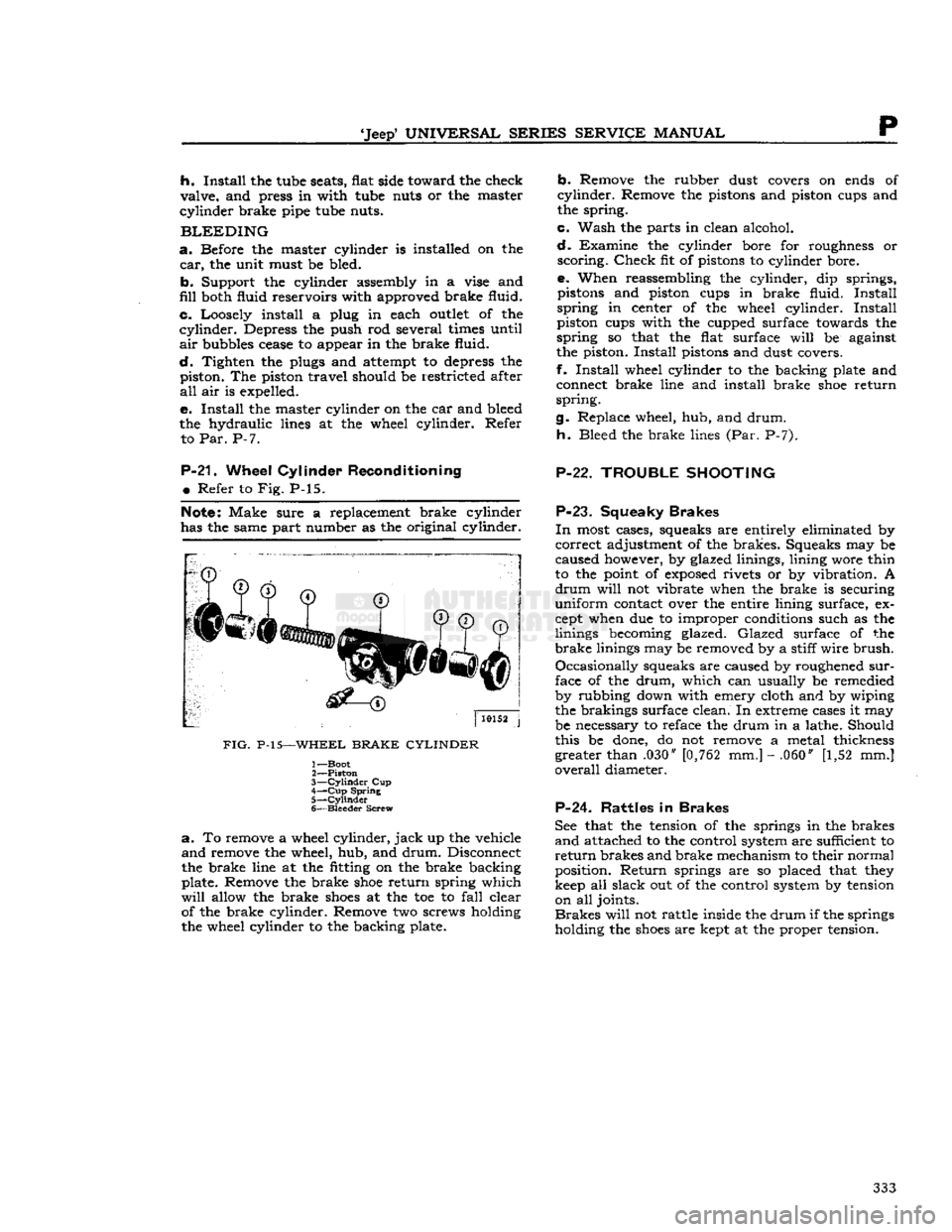
P-21.
Wheel
Cylinder
Reconditioning
•
Refer to Fig. P-15.
Note:
Make sure a replacement brake cylinder
has the same part number as the original cylinder.
FIG.
P-15—WHEEL
BRAKE CYLINDER
1— Boot
2—
Piston
3—
Cylinder
Cup
4—
Cup
Spring
5—
Cylinder
6—
Bleeder
Screw
a.
To remove a wheel cylinder,
jack
up the vehicle
and
remove the wheel, hub, and
drum.
Disconnect
the brake line at the fitting on the brake backing
plate. Remove the brake
shoe
return spring which
will
allow the brake
shoes
at the toe to
fall
clear of the brake cylinder. Remove two screws holding
the wheel cylinder to the backing plate.
b.
Remove the rubber dust covers on ends of
cylinder.
Remove the pistons and piston cups and
the spring.
c.
Wash the parts in clean alcohol.
d.
Examine the cylinder bore for roughness or
scoring.
Check
fit of pistons to cylinder bore.
e. When reassembling the cylinder, dip springs, pistons and piston cups in brake fluid.
Install
spring
in center of the wheel cylinder.
Install
piston cups with the cupped surface towards the
spring
so that the flat surface
will
be against
the piston.
Install
pistons and dust covers.
f.
Install
wheel cylinder to the backing plate and connect brake line and install brake
shoe
return
spring.
g. Replace wheel, hub, and
drum.
h.
Bleed the brake lines (Par. P-7).
P-22. TROUBLE
SHOOTING
P-23.
Squeaky
Brakes
In
most cases, squeaks are entirely eliminated by
correct
adjustment of the brakes. Squeaks may be
caused however, by glazed linings, lining wore thin
to the point of
exposed
rivets or by vibration. A
drum
will
not vibrate when the brake is securing
uniform
contact over the entire lining surface, ex
cept when due to improper conditions such as the
linings becoming glazed.
Glazed
surface of the
brake
linings may be removed by a stiff
wire
brush.
Occasionally
squeaks are caused by roughened
sur
face of the
drum,
which can usually be remedied
by rubbing down with emery cloth and by wiping
the brakings surface clean. In extreme cases it may
be necessary to reface the drum in a lathe. Should
this be done, do not remove a metal thickness greater than .030" [0,762 mm.] - .060" [1,52 mm.]
overall
diameter.
P-24. Rattles
in
Brakes
See that the tension of the springs in the brakes
and
attached to the control system are sufficient to
return
brakes and brake mechanism to their normal
position.
Return
springs are so placed that they
keep all slack out of the control system by tension on all joints.
Brakes
will
not rattle inside the
drum
if the springs
holding the
shoes
are kept at the proper tension. 333