1011 Mercury Grand Marquis brake light
[x] Cancel search: brake lightPage 195 of 333

Fuse/Relay
LocationFuse Amp
RatingProtected Circuits
8 10A Electronic automatic temperature
control (EATC) module (vehicles
equipped with EATC only)
9 7.5A Ignition (ON/ACC) - Door lock
switch illumination, Heated seat
switch illumination, Radio, Antenna,
Electrochromatic mirror, Window
relay coil, Decklid relay coil and
Police ON/ACC relay coil (Police
vehicles only)
10 15A Hazards (non-Police vehicles only)
20A Hazards (Police vehicles only)
11 15A Ignition (ON) - Turn signals
12 15A Audio
13 10A Ignition (ON) - rear air suspension
module (RASM), Cluster
14 15A Taxi, Adjustable pedals
15 10A Ignition (ON) - EATC module, A/C
mode switch (vehicles equipped
with manual A/C only), A/C blower
relay coil
16 20A On-board diagnostics (OBD II)
17 10A Ignition (ON) - A/C mode switch
(vehicles equipped with manual
A/C), Blend door, Heated seat
modules
18 15A LCM (interior lighting)
19 10A LCM (Left-hand low beam)
20 10A Ignition (ON/START) - Back-up
lamps, Anti-lock brake system
(ABS)
21 10A LCM (Right-hand low beam)
Roadside Emergencies
195
2011 Crown Victoria(cro)
Owners Guide, 3rd Printing
USA(fus)
Page 199 of 333
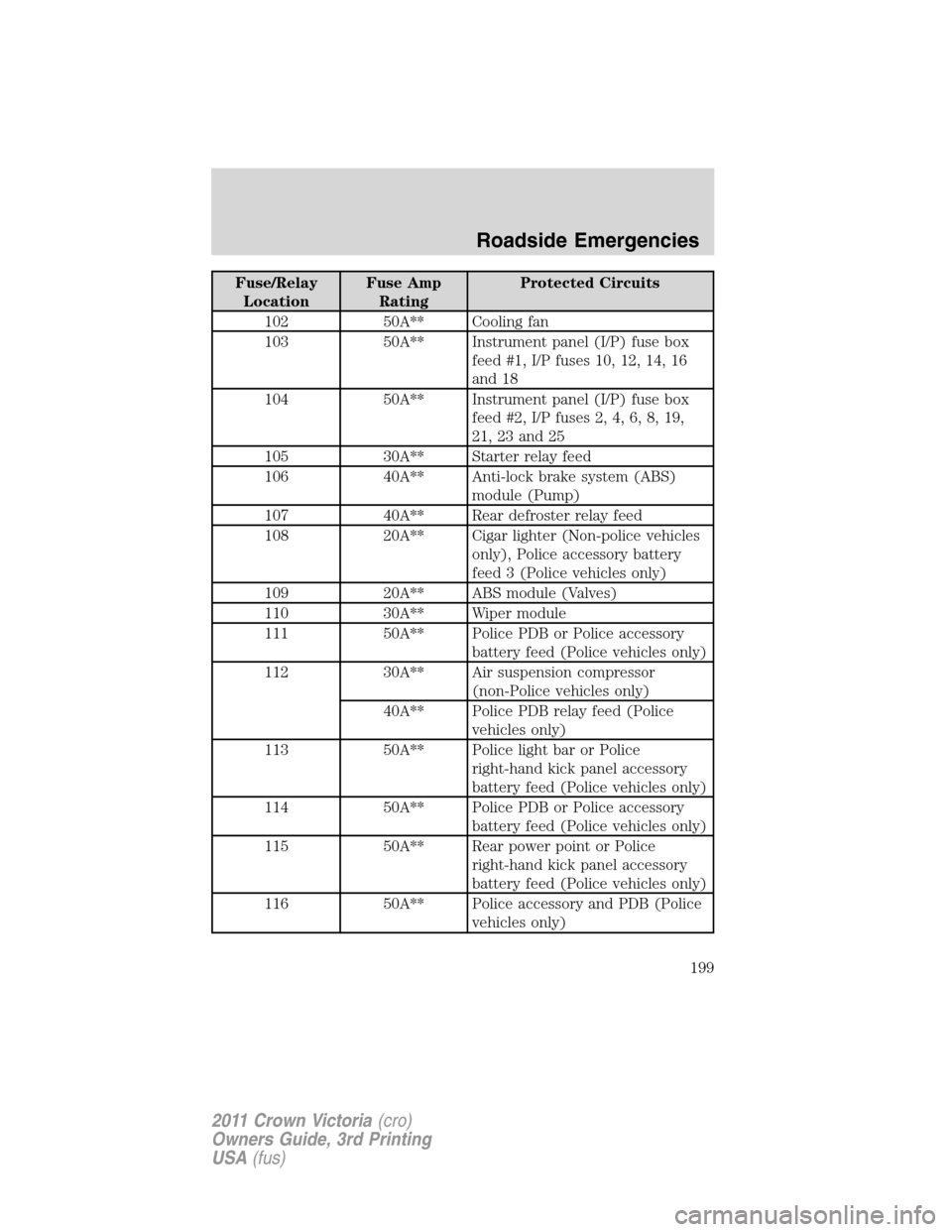
Fuse/Relay
LocationFuse Amp
RatingProtected Circuits
102 50A** Cooling fan
103 50A** Instrument panel (I/P) fuse box
feed #1, I/P fuses 10, 12, 14, 16
and 18
104 50A** Instrument panel (I/P) fuse box
feed #2, I/P fuses 2, 4, 6, 8, 19,
21, 23 and 25
105 30A** Starter relay feed
106 40A** Anti-lock brake system (ABS)
module (Pump)
107 40A** Rear defroster relay feed
108 20A** Cigar lighter (Non-police vehicles
only), Police accessory battery
feed 3 (Police vehicles only)
109 20A** ABS module (Valves)
110 30A** Wiper module
111 50A** Police PDB or Police accessory
battery feed (Police vehicles only)
112 30A** Air suspension compressor
(non-Police vehicles only)
40A** Police PDB relay feed (Police
vehicles only)
113 50A** Police light bar or Police
right-hand kick panel accessory
battery feed (Police vehicles only)
114 50A** Police PDB or Police accessory
battery feed (Police vehicles only)
115 50A** Rear power point or Police
right-hand kick panel accessory
battery feed (Police vehicles only)
116 50A** Police accessory and PDB (Police
vehicles only)
Roadside Emergencies
199
2011 Crown Victoria(cro)
Owners Guide, 3rd Printing
USA(fus)
Page 201 of 333

CHANGING THE TIRES
If you get a flat tire while driving, do not apply the brake heavily.
Instead, gradually decrease your speed. Hold the steering wheel firmly
and slowly move to a safe place on the side of the road.
Note:The tire pressure monitoring system (TPMS) indicator light will
illuminate when the spare tire is in use. To restore the full functionality
of the monitoring system, all road wheels equipped with tire pressure
monitoring sensors must be mounted on the vehicle.
Have a flat serviced by an authorized dealer in order to prevent damage
to the TPMS sensors, refer toTire pressure monitoring system
(TPMS)in theTires, Wheels and Loadingchapter. Replace the spare
tire with a road tire as soon as possible. During repairing or replacing of
the flat tire, have the authorized dealer inspect the TPMS sensor for
damage.
WARNING:The use of tire sealants may damage your tire
pressure monitoring system (TPMS) and should not be used.
However, if you must use a sealant, the TPMS sensor and valve stem
on the wheel must be replaced by an authorized Ford dealer.
WARNING:Refer toTire pressure monitoring system (TPMS)
in theTires, Wheels and Loadingchapter for important
information. If the tire pressure monitor sensor becomes damaged, it
will no longer function.
Dissimilar spare tire/wheel information
WARNING:Failure to follow these guidelines could result in an
increased risk of loss of vehicle control, injury or death.
If you have a dissimilar spare tire/wheel, then it is intended for
temporary use only. This means that if you need to use it, you should
replace it as soon as possible with a road tire/wheel that is the same size
and type as the road tires and wheels that were originally provided by
Ford. If the dissimilar spare tire or wheel is damaged, it should be
replaced rather than repaired.
Roadside Emergencies
201
2011 Crown Victoria(cro)
Owners Guide, 3rd Printing
USA(fus)
Page 243 of 333

•Theservice engine soonindicator light will illuminate.
•The message center (if equipped) will display COOLANT OVER
TEMPERATURE.
•The
symbol will illuminate.
If the engine reaches a preset over-temperature condition, the engine
will automatically switch to alternating cylinder operation. Each disabled
cylinder acts as an air pump and cools the engine.
When this occurs the vehicle will still operate. However:
•The engine power will be limited.
•The air conditioning system will be disabled.
Continued operation will increase the engine temperature:
•The engine will completely shut down, causing steering and braking
effort to increase.
Once the engine temperature cools, the engine can be re-started. Take
your vehicle to an authorized dealer as soon as possible to minimize
engine damage.
When fail-safe mode is activated
You have limited engine power when in the fail-safe mode, so drive the
vehicle with caution. The vehicle will not be able to maintain high-speed
operation and the engine will run rough. Remember that the engine is
capable of completely shutting down automatically to prevent engine
damage, therefore:
1. Pull off the road as soon as safely possible and turn off the engine.
2. Arrange for the vehicle to be taken to an authorized dealer.
3. If this is not possible, wait a short period for the engine to cool.
4. Check the coolant level and replenish if low.
WARNING:Fail-safe mode is for use during emergencies only.
Operate the vehicle in fail-safe mode only as long as necessary to
bring the vehicle to rest in a safe location and seek immediate repairs.
When in fail-safe mode, the vehicle will have limited power, will not be
able to maintain high-speed operation, and may completely shut down
without warning, potentially losing engine power, power steering assist,
and power brake assist, which may increase the possibility of a crash
resulting in serious injury.
Maintenance and Specifications
243
2011 Crown Victoria(cro)
Owners Guide, 3rd Printing
USA(fus)
Page 253 of 333

•Warming up a vehicle on cold mornings is not required and may
reduce fuel economy.
•Resting your foot on the brake pedal while driving may reduce fuel
economy.
•Combine errands and minimize stop-and-go driving.
Maintenance
•Keep tires properly inflated and use only recommended size.
•Operating a vehicle with the wheels out of alignment will reduce fuel
economy.
•Use recommended engine oil. Refer toMaintenance product
specifications and capacitiesin this chapter.
•Perform all regularly scheduled maintenance items. Follow the
recommended maintenance schedule and owner maintenance checks
found inscheduled maintenance information.
Conditions
•Heavily loading a vehicle or towing a trailer may reduce fuel economy
at any speed.
•Carrying unnecessary weight may reduce fuel economy (approximately
1 mpg [0.4 km/L] is lost for every 400 lb [180 kg] of weight carried).
•Adding certain accessories to your vehicle (for example bug
deflectors, rollbars/light bars, running boards, ski racks) may reduce
fuel economy.
•Using fuel blended with alcohol may lower fuel economy.
•Fuel economy may decrease with lower temperatures during the first
8–10 miles (12–16 km) of driving.
•Driving on flat terrain offers improved fuel economy as compared to
driving on hilly terrain.
•Transmissions give their best fuel economy when operated in the top
cruise gear and with steady pressure on the gas pedal.
•Close windows for high speed driving.
Maintenance and Specifications
253
2011 Crown Victoria(cro)
Owners Guide, 3rd Printing
USA(fus)
Page 261 of 333

VEHICLE STORAGE
If you plan on storing your vehicle for an extended period of time
(30 days or more), refer to the following maintenance recommendations
to ensure your vehicle stays in good operating condition.
All motor vehicles and their components were engineered and tested for
reliable, regular driving. Long term storage under various conditions may
lead to component degradation or failure unless specific precautions are
taken to preserve the components.
General
•Store all vehicles in a dry, ventilated place.
•Protect from sunlight, if possible.
•If vehicles are stored outside, they require regular maintenance to
protect against rust and damage.
Body
•Wash vehicle thoroughly to remove dirt, grease, oil, tar or mud from
exterior surfaces, rear-wheel housing and underside of front fenders.
See theCleaningchapter for more information.
•Periodically wash vehicles stored in exposed locations.
•Touch-up raw or primed metal to prevent rust.
•Cover chrome and stainless steel parts with a thick coat of auto wax
to prevent discoloration. Re-wax as necessary when the vehicle is
washed. See theCleaningchapter for more information.
•Lubricate all hood, door and trunk lid hinges, and latches with a light
grade oil. See theCleaningchapter for more information.
•Cover interior trim to prevent fading.
•Keep all rubber parts free from oil and solvents.
Engine
•The engine oil and filter should be changed prior to storage, as used
engine oil contain contaminates that may cause engine damage.
•Start the engine every 15 days. Run at fast idle until it reaches normal
operating temperature.
•With your foot on the brake, shift through all the gears while the
engine is running.
Fuel system
•Fill the fuel tank with high-quality fuel until the first automatic shutoff
of the fuel pump nozzle.
Maintenance and Specifications
261
2011 Crown Victoria(cro)
Owners Guide, 3rd Printing
USA(fus)
Page 276 of 333

WHEELS/TIRES/BRAKES
Wheel rims - police
To withstand the demands placed on vehicles driven under heavy duty
service conditions, Ford Motor Company installs heavy duty steel wheels.
Tires - police
Tires (including the spare) are speed-rated radials for police use. Use
only the recommended tire size and speed ratings.
In regions with snow and ice during the winter months, installation of
snow tires may be desirable. Snow tires will usually exhibit a drop in dry
pavement handling, but many show an increase in snow and ice traction.
When snow tires are used, they should be installed on all four wheels,
never on the drive wheels only.
Tires - long term storage
Most high performance tires are made with a nylon overlay.
As such, the following steps should be taken to avoid flatspotting when
the vehicles are not used for a period of time.
•Fleets should store the vehicles with 44 psi (303 kPa) in the tires.
•If the vehicle is stored for periods longer than 30 days, it should be
moved several feet at least once during each 30-day period, so that a
different portion of the tread contacts the ground.
•Tire pressure should be reduced to the recommended pressure shown
on the vehicle certification label before the vehicle is placed back into
service.
Training the tire pressure monitoring system (TPMS)
All Crown Victorias are equipped
with a tire pressure monitoring
system (TPMS) that illuminates a
low tire pressure warning light on
the instrument cluster when one or
more of your tires is significantly under-inflated.
Crown Victoria Severe Duty
276
2011 Crown Victoria(cro)
Owners Guide, 3rd Printing
USA(fus)
Page 283 of 333

transceivers, garage door openers and other transmitters whose power
output is 5 watts or less will not ordinarily affect your vehicle’s
operation.)
Because we have no control over the installation, design or manufacture
of such systems, Ford cannot assume responsibility for any adverse
effects or damage that may result if you use this equipment.
Malfunction of aftermarket electronic equipment should be resolved by
the equipment manufacturer.
Aftermarket equipment installation
Ford has developed aPolice Interceptor Modifier Guideto assist the
vehicle modifier in safely installing police equipment into the vehicle.
The guide provides detailed information on the location of key vehicle
components that must be untouched and warnings for other areas where
caution must be exercised. The Modifier Guide is available for
downloading, free of charge, from www.fleet.ford.com.
When installing aftermarket equipment, avoid using fasteners that are too
long for the application or are in an area which might damage vehicle
components, including wiring, brake lines, fuel tank and lines, powertrain
components, exhaust system and suspension.
Also, do not make electrical connections to vehicle electrical systems not
specifically designed for aftermarket equipment installations. Refer to the
“Wiring Diagram Manual” for electrical system information.
Do not install any components into the powertrain control module
(PCM) or PCM harness. Connecting into this system may affect engine
and transmission operation.
As an example: connection of aftermarket electrical equipment into the
brake light circuit or any other circuit which is connected to the PCM,
anti-lock brake computer, airbag system or any other vehicle system
which will cause vehicle malfunction.
WARNING:Contact during a crash with aftermarket equipment
in a vehicle can result in a personal injury.
WARNING:Installation of prisoner barriers may increase the
risk of injury to front seat occupants if the vehicle is impacted
from the rear at high speeds. This risk should be balanced, by the law
enforcement agency, against the risk of injury to the Officer associated
with prisoner transport.
Crown Victoria Severe Duty
283
2011 Crown Victoria(cro)
Owners Guide, 3rd Printing
USA(fus)